The Best Online Astronomy Forums and Communities for Backyard Observers in 2026
Finding the right online community can transform your astronomy hobby from a solitary pursuit into a shared adventure. The best astronomy forums offer more than just technical advice. They provide friendship, inspiration, and the collective wisdom of thousands of observers who have pointed their telescopes at the same objects you’re trying to find tonight.
The best astronomy forums combine active communities, searchable archives, and experienced members willing to help beginners. Cloudy Nights excels for equipment discussions, Stargazers Lounge serves international observers, and Reddit’s r/telescopes provides fast answers. Most successful amateur astronomers participate in multiple communities, each offering different strengths for equipment reviews, astrophotography feedback, observing reports, and technical troubleshooting.
Why Online Astronomy Communities Matter
Backyard astronomy can feel isolating. You’re outside in the dark while everyone else sleeps. When you finally spot that galaxy or resolve a double star, there’s often nobody around to share the moment.
Online forums solve this problem beautifully. They connect you with people who understand why you’re excited about seeing Saturn’s rings for the first time or frustrated because your telescope won’t collimate properly.
These communities also accelerate your learning. Instead of making every mistake yourself, you can learn from others who have already been there. Someone has already tested that eyepiece you’re considering. Someone else knows exactly why your star images look elongated.
The knowledge base in established forums represents decades of collective experience. Search functions let you find answers to problems that stumped observers years ago. This searchable history is often more valuable than any single expert’s advice.
Top Forums for Equipment Discussions
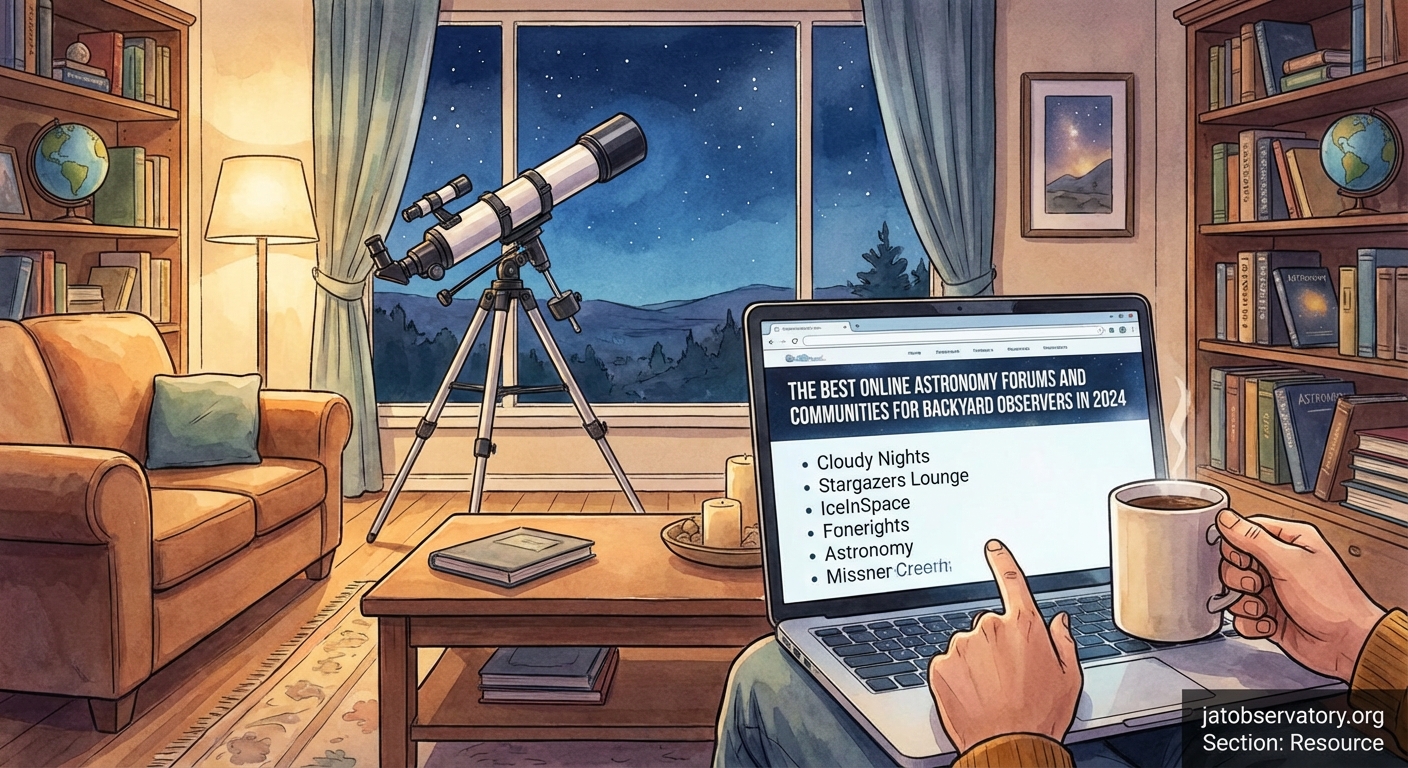
Cloudy Nights remains the gold standard for telescope and equipment talk. The forum has been running since 2001, building an enormous archive of reviews, comparisons, and troubleshooting threads.
The classifieds section alone makes membership worthwhile. You’ll find used equipment from trusted community members, often at better prices than eBay. Sellers have reputations to protect, so transactions tend to go smoothly.
The reviews section contains detailed, honest assessments of nearly every telescope, eyepiece, and accessory on the market. These aren’t marketing copy. They’re real observations from people who spent their own money and tested gear under actual sky conditions.
Stargazers Lounge serves a similar function for international observers, particularly those in Europe. The community skews slightly more casual than Cloudy Nights, making it friendlier for absolute beginners.
Their “What Should I Buy?” subforum gets beginners pointed in the right direction fast. Experienced members ask the right questions about budget, observing location, and interests before making recommendations.
Communities for Astrophotography
Cloudy Nights Astrophotography Forum splits from the main equipment discussions to focus specifically on imaging. The technical level runs high, but members remain patient with newcomers.
Post an image with your equipment details and processing steps, and you’ll receive specific feedback. Members will suggest exactly which processing adjustment to make or which piece of equipment to upgrade next.
The beginner astrophotography subforum provides a less intimidating space for first attempts. Nobody expects perfection. Everyone remembers their own early struggles with tracking, focusing, and stacking.
r/astrophotography on Reddit offers faster feedback cycles. Post an image and you’ll often get responses within hours. The community has strict posting rules requiring equipment details and acquisition data, which keeps the quality high.
The subreddit’s wiki contains excellent tutorials for getting started. The guides assume no prior knowledge and walk through the entire process from equipment selection through final processing.
Forums for Visual Observers
Cloudy Nights Deep Sky Observing focuses on what you can see through an eyepiece rather than a camera. Members share observing reports, sketch their observations, and discuss techniques for seeing faint objects.
The sketching subforum deserves special mention. Drawing what you see trains your eye to notice subtle details. Members provide encouragement and tips for improving observational skills.
Stargazers Lounge Observing Reports section reads like a collection of astronomy journals. Members describe their observing sessions, list objects viewed, note seeing conditions, and share what worked or didn’t.
Reading these reports before an observing session helps you plan your own night. You’ll learn which objects are visible in light polluted skies and which require dark conditions.
Reddit Communities for Fast Answers
r/telescopes answers beginner questions with remarkable patience. The same “which telescope should I buy” question gets asked daily, yet members continue providing thoughtful, personalized responses.
The subreddit’s sticky posts and wiki contain everything a beginner needs to know. Read those first, and you’ll avoid common mistakes like buying a department store telescope or choosing the wrong mount type.
r/astronomy covers broader topics beyond equipment. Members discuss recent discoveries, share news articles, and answer questions about astronomical phenomena.
The community size means posts get visibility fast. Ask a question and you’ll typically see multiple responses within an hour.
Specialized Communities Worth Joining
Some forums focus on specific aspects of amateur astronomy. These specialized communities offer deeper expertise in their niches.
Astrobin functions as both an image hosting platform and a community. Photographers can see exactly what equipment and settings produced each image. This transparency helps you understand what’s possible with gear similar to yours.
Ice in Space serves Australian and Southern Hemisphere observers. Northern hemisphere observers miss this perspective. The southern sky contains objects that never rise above northern horizons.
Starry Night Education forums help users of that particular planetarium software but also discuss general observing planning and sky simulation techniques.
How to Choose the Right Forum for You
Different forums serve different needs. Most successful amateur astronomers participate in several communities rather than committing to just one.
Consider these factors when selecting forums to join:
- Activity level: Check recent post dates. Some forums have declined into ghost towns where questions go unanswered for days.
- Community culture: Read through several threads to gauge tone. Some communities tolerate arguments and harsh criticism. Others maintain friendlier atmospheres.
- Search functionality: Good search tools let you find existing answers instead of asking repeated questions.
- Mobile accessibility: If you’ll participate from your phone during observing sessions, mobile friendly design matters.
- Geographic relevance: Local weather, light pollution, and available equipment vary by region.
Getting the Most from Forum Membership
Joining a forum is easy. Becoming a valued member takes more effort. These strategies help you build reputation and get better responses to your questions.
- Read the sticky posts and FAQ sections first. Your question has probably been answered already. Finding that existing answer is faster than waiting for responses.
- Use descriptive thread titles. “Help with telescope” gets ignored. “Skywatcher 8 inch collimation problem” attracts people who can actually help.
- Provide complete information. Include your equipment, location, experience level, and what you’ve already tried. Vague questions get vague answers.
- Post images when relevant. A photo of your setup or the problem you’re experiencing is worth paragraphs of description.
- Follow up on advice received. Let people know whether their suggestions worked. This feedback helps future readers and shows respect for the time people invested in helping you.
- Contribute answers when you can. Even beginners know something that newer beginners don’t. Answering questions builds community and reinforces your own learning.
Common Forum Mistakes to Avoid
New members often make predictable errors that hurt their forum experience. Avoiding these pitfalls helps you get better help faster.
| Mistake | Why It Matters | Better Approach |
|---|---|---|
| Asking without searching first | Wastes everyone’s time on repeated questions | Spend 10 minutes searching before posting |
| Posting in wrong subforum | Right experts won’t see your question | Read forum structure before posting |
| Getting defensive about advice | Discourages people from helping you | Thank people even if you disagree |
| Bumping threads too soon | Makes you look impatient and entitled | Wait at least 24 hours before bumping |
| Ignoring formatting | Makes posts hard to read | Use paragraphs and proper spacing |
| Hijacking other threads | Confuses discussions and annoys members | Start your own thread for your question |
Understanding Forum Culture and Etiquette
Each forum develops its own culture over time. Learning these unwritten rules helps you fit in faster.
Most astronomy forums value politeness and patience. Members remember that everyone started as a beginner. Condescension toward newcomers gets called out quickly.
Brand loyalty debates can turn heated. Some members strongly prefer certain manufacturers or telescope designs. State your preferences without attacking others’ choices.
The best forum advice I ever received was to observe more and buy less. Every experienced amateur astronomer I’ve learned from emphasizes that skill development matters more than equipment upgrades. Your telescope doesn’t limit you nearly as much as you think it does.
Astrophotography forums sometimes struggle with jealousy and competition. Someone always has darker skies, better equipment, or more processing skill. Focus on improving your own work rather than comparing yourself to others.
Forums Versus Social Media Groups
Facebook groups and Discord servers have grown popular for astronomy discussions. These platforms offer different advantages and disadvantages compared to traditional forums.
Speed: Social media provides faster responses. Someone is always online in large groups.
Searchability: Traditional forums win here. Facebook’s search function is terrible. Discord is even worse. Years of valuable advice becomes effectively lost.
Organization: Forums use subforum structures and thread tags to organize content. Social media just scrolls endlessly.
Permanence: Forum posts stay accessible for years. Social media posts get buried quickly.
Atmosphere: Social media feels more casual and conversational. Forums tend toward more formal, detailed responses.
Many observers use both. They ask urgent questions in social media groups and research detailed topics in forum archives.
Building Your Personal Learning Network
The most successful amateur astronomers build networks across multiple platforms. Each community offers different strengths.
Start with one or two major forums like Cloudy Nights or Stargazers Lounge. Learn the culture and build some reputation.
Add a Reddit community for fast answers to simple questions.
Join a Facebook group or Discord server for your specific geographic region. Local observers can recommend dark sky sites, warn about weather, and organize star parties.
Follow experienced astrophotographers on Astrobin or Instagram for inspiration and technique ideas.
Subscribe to a few YouTube channels for visual learning. Many forum members also create video content.
This multi platform approach provides different perspectives and learning styles. Some people explain concepts better in writing. Others excel at visual demonstrations.
Recognizing Quality Advice
Not all forum advice is equally valuable. Learning to evaluate responses helps you avoid bad information.
Check the advisor’s post count and join date. Long term members with thousands of posts have earned trust through consistent, accurate advice.
Look for specificity. Vague advice like “just practice more” helps less than detailed suggestions with exact settings or techniques.
Notice whether the advisor asks clarifying questions. Good helpers want to understand your specific situation before recommending solutions.
Be cautious of advice that contradicts multiple other responses. Astronomy has some debates, but basic facts are well established.
Watch for commercial interests. Some members work for equipment vendors and may push specific products. This doesn’t make their advice wrong, but consider potential bias.
When to Take Forum Advice Offline
Forums excel at information sharing but have limits. Some situations require in person help.
Collimation and telescope assembly often need hands on guidance. Reading instructions helps, but having someone show you the process once makes everything clear.
Star parties and astronomy club meetings let you see equipment in action. You can look through different telescopes and ask owners about their experiences.
Many forum members attend the same events. Meeting online friends in person strengthens relationships and builds trust.
Local astronomy clubs often have experienced members who also participate in online forums. These people can provide both online and in person support.
Your Next Step in the Astronomy Community
Creating your first forum account feels like a small step. It opens doors to a worldwide community of people who share your passion for the night sky.
Start by introducing yourself in the new members section. Mention your location, equipment, and interests. You’ll receive welcomes and probably some immediate advice.
Then spend time reading before posting questions. You’ll learn the community’s personality and discover answers to questions you didn’t know you had.
When you do ask your first question, remember that every expert in that forum once stood exactly where you stand now. They remember feeling confused and overwhelmed. Most of them genuinely enjoy helping newcomers because someone once helped them.
The best astronomy forums become more than information sources. They become communities where you make friends, share frustrations, celebrate successes, and grow as an observer. Your first clear night with a new telescope becomes more meaningful when you can share the experience with people who understand exactly why it matters.

Post Comment