5 Celestial Events That Shaped Astrological Traditions and How to Observe Them Today
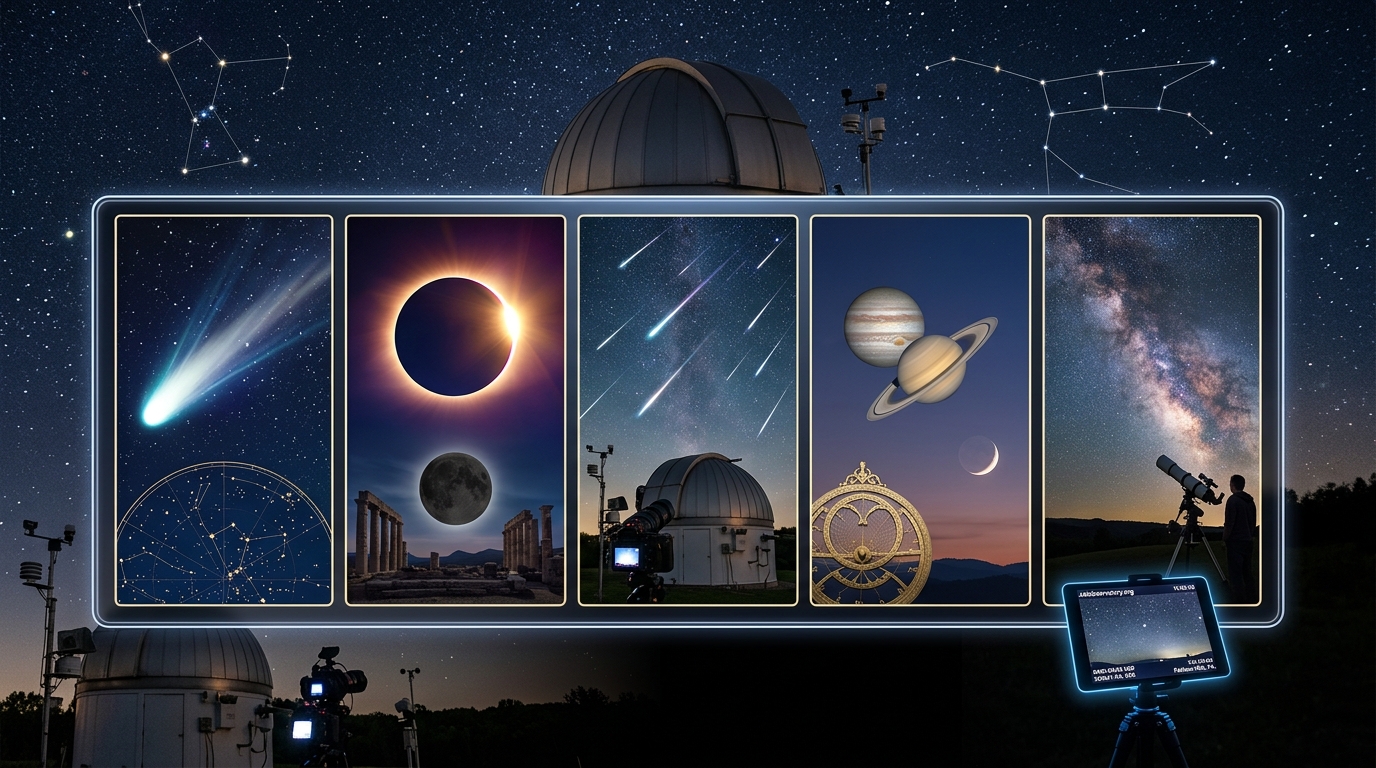
The night sky has been humanity’s first teacher, calendar, and source of wonder. Certain astronomical events didn’t just light up the darkness. They changed how entire civilizations understood time, destiny, and their place in the cosmos.
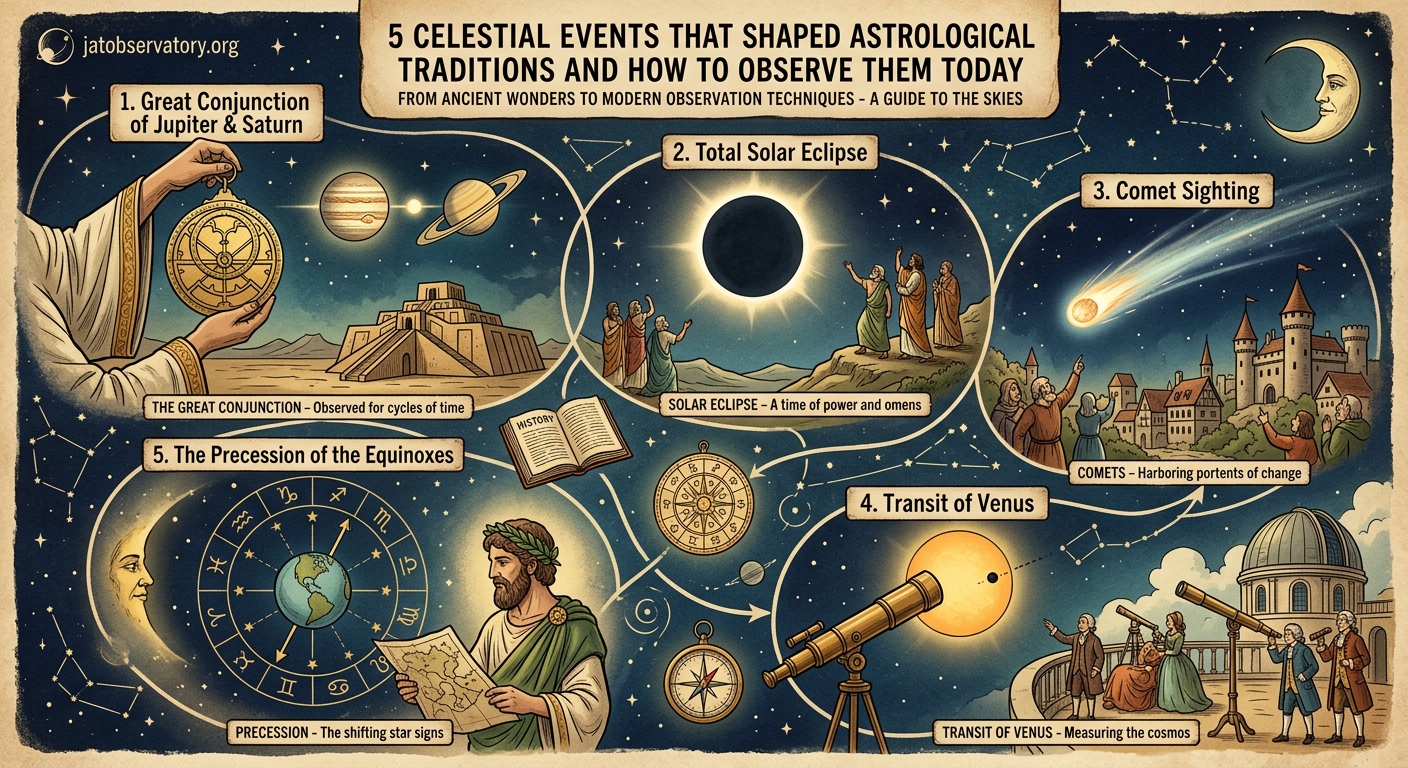
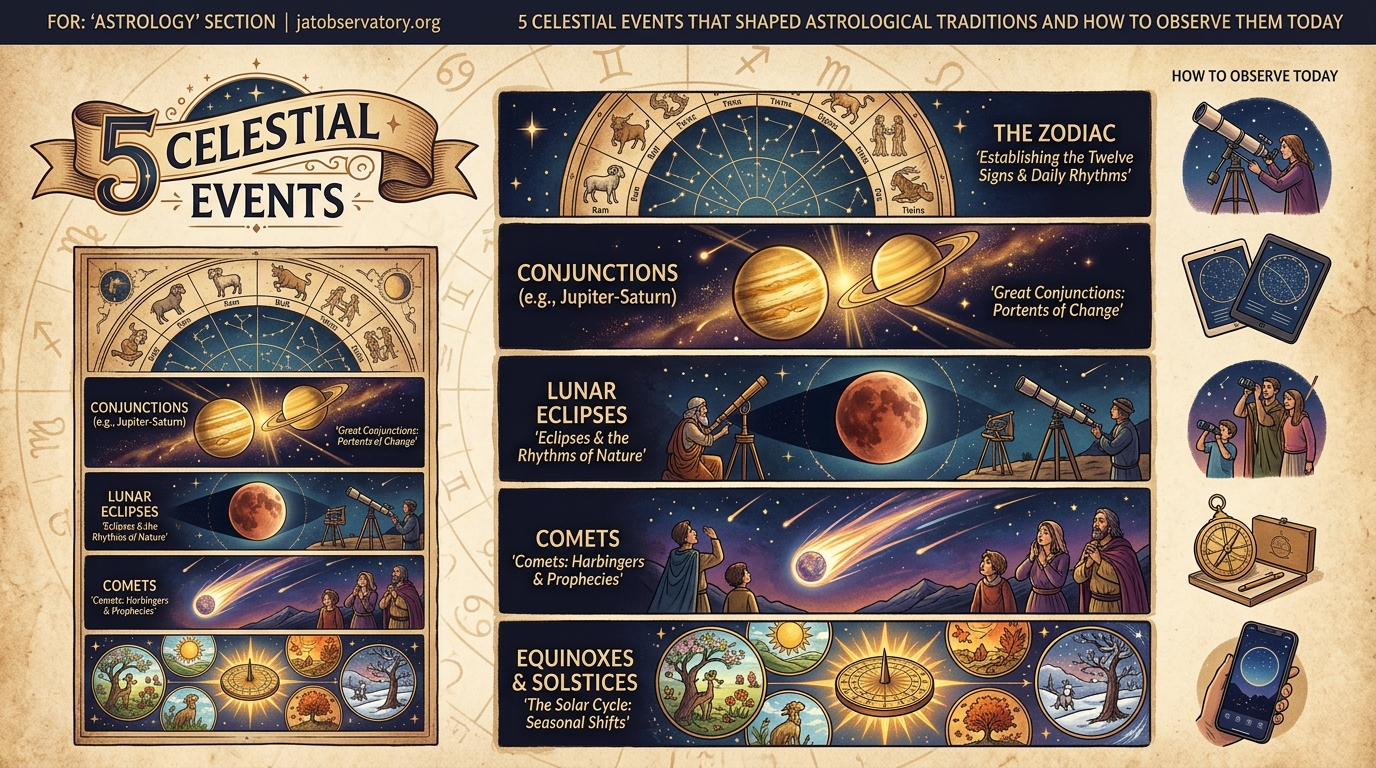
Throughout history, specific celestial events have fundamentally shaped astrological traditions across cultures. From ancient eclipse predictions to planetary conjunctions, these phenomena influenced agricultural calendars, religious practices, and royal decisions. Modern observers can still witness these same events using basic equipment and free software, connecting directly with the astronomical moments that changed human civilization.
The total solar eclipse that proved prediction was possible
Ancient Babylonian astronomers tracked celestial patterns with obsessive detail. Their clay tablets recorded every lunar eclipse, every planetary position, every unusual sky event.
Then came the Saros cycle discovery.
By recognizing that eclipses repeat every 18 years, 11 days, and 8 hours, these early sky watchers transformed astronomy from observation into prediction. Suddenly, the future wasn’t just unknowable. It was calculable.
This breakthrough didn’t stay in Mesopotamia. Greek astronomers adopted and refined these cycles. Chinese imperial astronomers used eclipse predictions to maintain their authority. A successful prediction meant divine favor. A missed eclipse could cost an astronomer their position, or worse.
The most famous historical eclipse occurred on May 28, 585 BCE. According to Herodotus, this total solar eclipse stopped a battle between the Medes and Lydians mid-fight. The sudden darkness terrified both armies into a peace treaty.
Whether the story is entirely accurate matters less than what it represents. Eclipses held power over human decisions at the highest levels.
How to observe solar eclipses today
Modern eclipse chasing requires planning but not enormous expense.
- Check NASA’s eclipse predictions for the next decade at their official eclipse website
- Obtain ISO 12312-2 certified eclipse glasses from reputable astronomy suppliers
- Set up your observation location along the path of totality for maximum effect
- Use free sky mapping software every remote observatory owner should know about to plan exact timing
- Consider a simple DSLR camera with solar filter for documentation
“The difference between a partial eclipse and totality is the difference between interesting and life-changing. Always chase totality if you can.” — Dr. Kate Russo, eclipse psychologist
Halley’s Comet and the birth of periodic prediction
Edmond Halley did something remarkable in 1705. He looked at historical comet records and noticed a pattern.
Bright comets had appeared in 1531, 1607, and 1682. Each roughly 76 years apart.
He predicted the same comet would return in 1758.
Halley died in 1742, sixteen years before his prediction could be tested. But on Christmas night 1758, amateur astronomer Johann Georg Palitzsch spotted it exactly where Halley’s calculations suggested.
This single prediction changed everything. Comets weren’t random omens anymore. They were predictable celestial bodies following Newton’s laws.
Before Halley, comets terrified people. The Great Comet of 1066 appeared just before the Norman Conquest of England. It’s stitched into the Bayeux Tapestry as a harbinger of doom. Medieval Europeans saw comets as divine warnings of plague, war, or the death of kings.
After Halley’s successful prediction, comets became scientific objects. The shift from omen to orbit took centuries of cultural adjustment.
| Historical View | Modern Understanding |
|---|---|
| Divine warnings or supernatural signs | Icy bodies from the outer solar system |
| Unpredictable appearances | Calculable orbits with return periods |
| Bearers of plague or disaster | Sources of water and organic compounds |
| Unique individual events | Members of comet families and groups |
Photographing comets from your backyard
You don’t need a professional observatory to capture these visitors from the outer solar system. The techniques for photographing the Andromeda Galaxy from a suburban backyard observatory work equally well for bright comets.
- Use a DSLR or mirrorless camera on a sturdy tripod
- Start with 10-30 second exposures at ISO 1600-3200
- A 50mm or 85mm lens captures both comet and landscape context
- Stack multiple exposures to reduce noise and enhance detail
- Time your session for when the comet is highest above the horizon
Halley’s Comet returns in 2061. Mark your calendar now.
The Great Conjunction of 1623 and astrological ages
Every 20 years, Jupiter and Saturn appear to meet in the sky. These Great Conjunctions have marked major astrological transitions for millennia.
But some conjunctions matter more than others.
For roughly 200 years, these meetings occur in signs of the same element. Then the pattern shifts to a new element. These transitions between elemental triplicities supposedly herald new historical eras.
The 1623 conjunction was special. It happened in Cancer, marking the last water-sign meeting before a shift to fire signs. Some astrologers connected it to the Thirty Years’ War. Others saw it as marking the scientific revolution.
More famously, some scholars suggest the Star of Bethlehem was actually a Great Conjunction in 7 BCE. The timing aligns with historical estimates of Jesus’s birth. Jupiter and Saturn met three times that year in Pisces, creating an unusually bright and prolonged celestial display.
The December 2020 conjunction brought Jupiter and Saturn closer in apparent distance than they’d been since 1623. Separated by just 0.1 degrees, they appeared almost as a single brilliant point of light.
Observing planetary conjunctions
How planetary alignments actually look through a backyard telescope reveals that these events are more subtle than artistic renderings suggest. But they’re still spectacular.
For the next Great Conjunction in 2040:
- Use binoculars or a small telescope to see both planets in the same field of view
- Start observing a week before the closest approach to watch their dance
- Note how Jupiter’s moons and Saturn’s rings remain visible even at conjunction
- Photograph the event with a telephoto lens (200-400mm works well)
- Compare your observations with historical accounts and artwork
The planets don’t actually come close in space. They just appear aligned from our perspective on Earth. Jupiter orbits at 5.2 AU from the Sun. Saturn sits at 9.5 AU. But the visual effect still captivates.
The 1054 supernova and the Crab Nebula
Chinese astronomers in the Song Dynasty kept meticulous records. On July 4, 1054, they noted a “guest star” appearing near the constellation we now call Taurus.
This star was so bright it remained visible in daylight for 23 days. At night, you could read by its light. It outshone Venus at its brightest.
Then, over the following months, it faded. Within two years, it disappeared completely from naked-eye visibility.
Native American rock art in Chaco Canyon may depict this same event. A pictograph shows a crescent moon near a bright star, matching the sky configuration on July 5, 1054.
What those ancient observers witnessed was a supernova. A massive star exploding at the end of its life, briefly outshining an entire galaxy.
Today, we can still see the remnant. The Crab Nebula (M1) sits exactly where Chinese astronomers recorded their guest star. It’s expanding at 1,500 kilometers per second. At its center, a pulsar spins 30 times per second, the collapsed core of the original star.
This single event influenced Chinese astrology for centuries. Guest stars were interpreted as omens, their meanings debated by imperial advisors. The 1054 appearance occurred during a period of political stability, which some astrologers later claimed it predicted.
Finding the Crab Nebula yourself
You can observe the same object that medieval astronomers saw explode.
- Locate the constellation Taurus in winter evening skies
- Find the star Zeta Tauri at the tip of the southern horn
- Move about 1 degree north and slightly west
- Through binoculars, it appears as a faint fuzzy patch
- A telescope at 100x magnification reveals its oval shape
- Long-exposure photography shows the intricate filament structure
An all-sky camera setup complete guide from hardware to first light can help you monitor the entire sky for unexpected transient events, though supernovae visible to the naked eye are rare.
The Leonid meteor storm of 1833 and celestial mechanics
November 13, 1833, started as an ordinary night. It ended with thousands of Americans convinced the world was ending.
Meteors began falling after midnight. Not the occasional shooting star of a normal meteor shower. Hundreds per minute. Thousands per hour. Witnesses described the sky as filled with falling stars, like snow in a blizzard.
The Leonid meteor storm terrified and amazed observers across North America. Religious interpretations dominated. Many saw it as a sign of the apocalypse. Camp meetings and revivals surged in the following months.
But a few astronomers recognized an opportunity.
Denison Olmsted at Yale College gathered eyewitness accounts from across the continent. He noticed that all the meteors appeared to radiate from the constellation Leo. This radiant point moved with the stars, proving the meteors came from space rather than Earth’s atmosphere.
His analysis helped establish that meteor showers are annual events caused by Earth passing through debris trails left by comets. The Leonids specifically come from Comet Tempel-Tuttle, which orbits the Sun every 33 years.
The 1833 storm advanced meteor science from folklore to physics. It demonstrated that celestial mechanics could explain even the most spectacular sky phenomena.
Capturing meteor showers
The Leonids still peak every November, though storm-level activity only occurs when Comet Tempel-Tuttle passes near Earth. The next potential storm is predicted for 2034.
For regular annual showers:
- Set up during the peak night listed in annual meteor shower calendars
- Position yourself away from city lights after midnight
- Bring a reclining chair and warm clothing
- Let your eyes adapt to darkness for 20-30 minutes
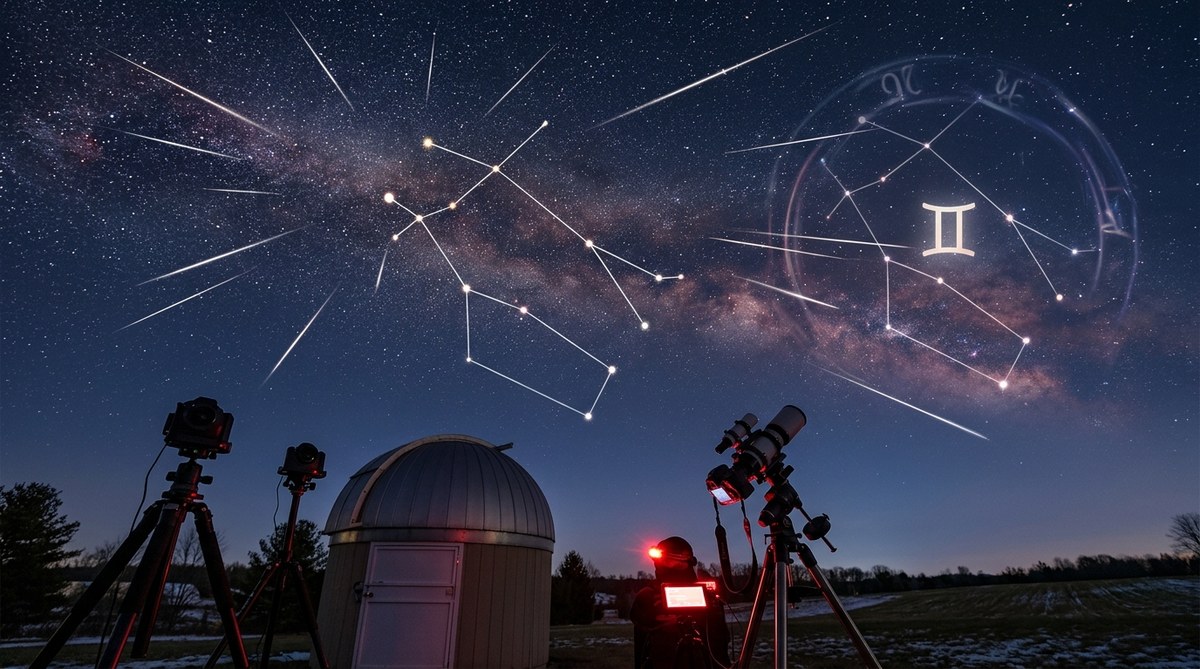
- Point a camera with a wide-angle lens at the radiant constellation
- Use 15-30 second exposures continuously throughout the night
Some observers use unexpected meteor shower captures our all-sky camera recorded this year as inspiration for their own setups. Automated systems can record meteors you might miss while blinking.
The best meteor showers occur when the Moon is absent and the radiant is high in the sky. The Perseids in August and Geminids in December consistently produce 60-120 meteors per hour under ideal conditions.
Common mistakes when observing historical celestial events
Modern observers sometimes approach these phenomena with unrealistic expectations or poor preparation.
| Mistake | Better Approach |
|---|---|
| Expecting dramatic visual effects like in photos | Understand that cameras gather more light than eyes |
| Observing from light-polluted urban centers | Drive to darker skies or use appropriate filters |
| Checking sky conditions only on the event night | Monitor weather forecasts starting a week ahead |
| Using equipment without prior practice | Test all gear during regular observing sessions |
| Ignoring Moon phase when planning observations | Schedule around New Moon for deep sky events |
The Moon’s influence on observation quality is real, though perhaps not in the way astrologers traditionally claimed. Tracking the Moon’s phases with a practical observer’s guide to lunar influence claims helps separate astronomical fact from astrological interpretation.
Understanding what ancient astronomers actually saw
Modern light pollution makes it hard to imagine the sky our ancestors observed. The Milky Way blazed overhead every clear night. Planets moved obviously against background stars. Meteor showers genuinely looked like falling stars.
What ancient astronomers got right and wrong about planetary motion shows how careful observation led to accurate predictions even with incorrect underlying models. The Ptolemaic system was wrong about Earth’s position but right about planetary positions for centuries.
Ancient observers had advantages we lack:
- Darker skies revealing fainter celestial objects
- Cultural emphasis on sky watching as practical necessity
- Generational knowledge transfer within astronomer-priest families
- Decades of personal observation building pattern recognition
They also faced limitations:
- No optical aid beyond the naked eye
- Inability to see beyond Earth’s atmosphere
- Lack of understanding about distances and scales
- Confusion between astronomical and atmospheric phenomena
The celestial events they recorded were identical to what we see today. Their interpretations differed. Their sense of wonder probably didn’t.
Setting up for your own historical observations
You can witness the same types of events that shaped ancient astrological traditions. The equipment requirements are modest.
Essential gear for most historical celestial events:
- Binoculars (10×50 or 7×35 are versatile starting points)
- Red flashlight for preserving night vision
- Star chart or planetarium app for identification
- Notebook for recording observations and impressions
- Comfortable seating for extended viewing sessions
Optional but valuable additions:
- Small telescope (4-8 inch aperture opens new possibilities)
- DSLR camera with tripod for documentation
- All-sky camera for automated monitoring
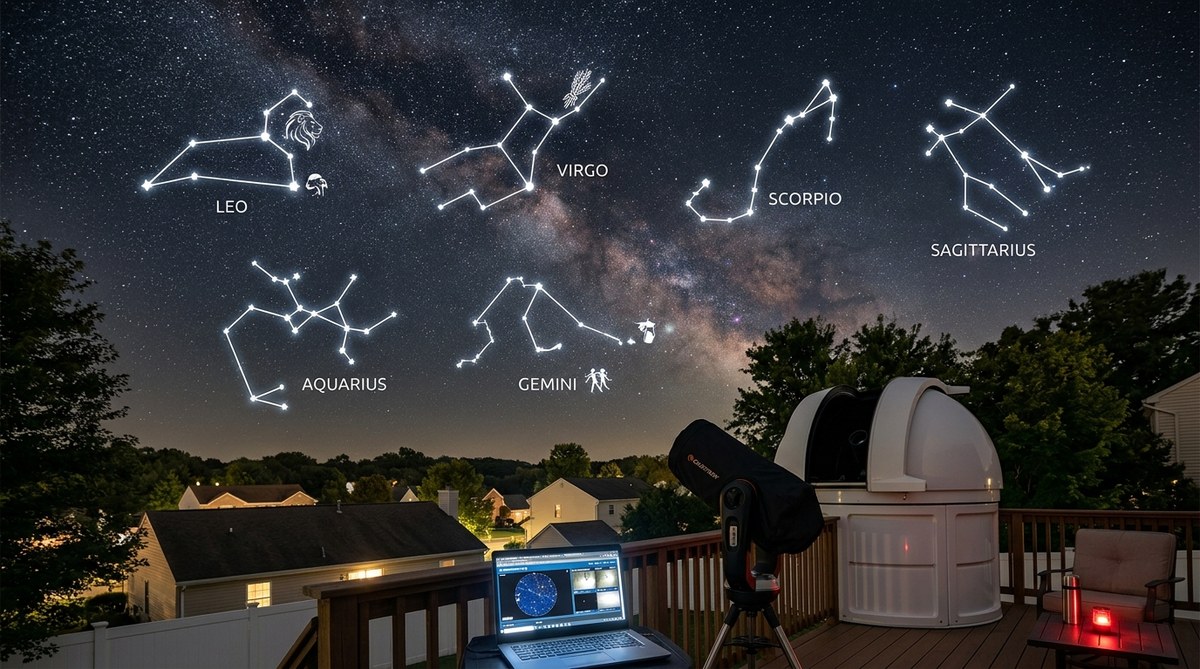
- Laptop running planetarium software for predictions
- Weather station to track observing conditions
The most important equipment is consistency. Regular observation builds the pattern recognition that ancient astronomers developed over lifetimes.
Why these moments still matter
Celestial events in history didn’t just influence the past. They connect us to an unbroken chain of human observers stretching back thousands of years.
When you watch a total solar eclipse, you’re seeing the same phenomenon that stopped ancient battles. When you spot Jupiter and Saturn in conjunction, you’re witnessing the same alignment that medieval astrologers interpreted as marking new eras. When meteors streak across your sky, you’re watching the same cosmic debris that terrified and amazed observers in 1833.
The difference is understanding. We know what causes these events now. We can predict them decades in advance. We can photograph them, analyze them, and explain them.
But the fundamental human response to the night sky hasn’t changed. Wonder, curiosity, and the desire to find meaning in the patterns above us remain constant across cultures and centuries.
The sky is still there, still performing its ancient dance. You just need to look up and give it the attention it deserves. Start tonight. Pick one historical event type. Learn when the next occurrence happens. Make a plan to observe it properly.
The same stars that guided ancient navigators and inspired mythologies still shine above you. The same planets that medieval astrologers tracked still wander against the background constellations. The same Moon that regulated agricultural calendars still cycles through its phases.
Your observations become part of that long tradition. Not as omens or prophecies, but as direct connection to the cosmos that has fascinated humanity since we first looked up and wondered what those lights meant.

Post Comment