Comparing Wide-Angle Lenses for Night Sky Webcam Installations
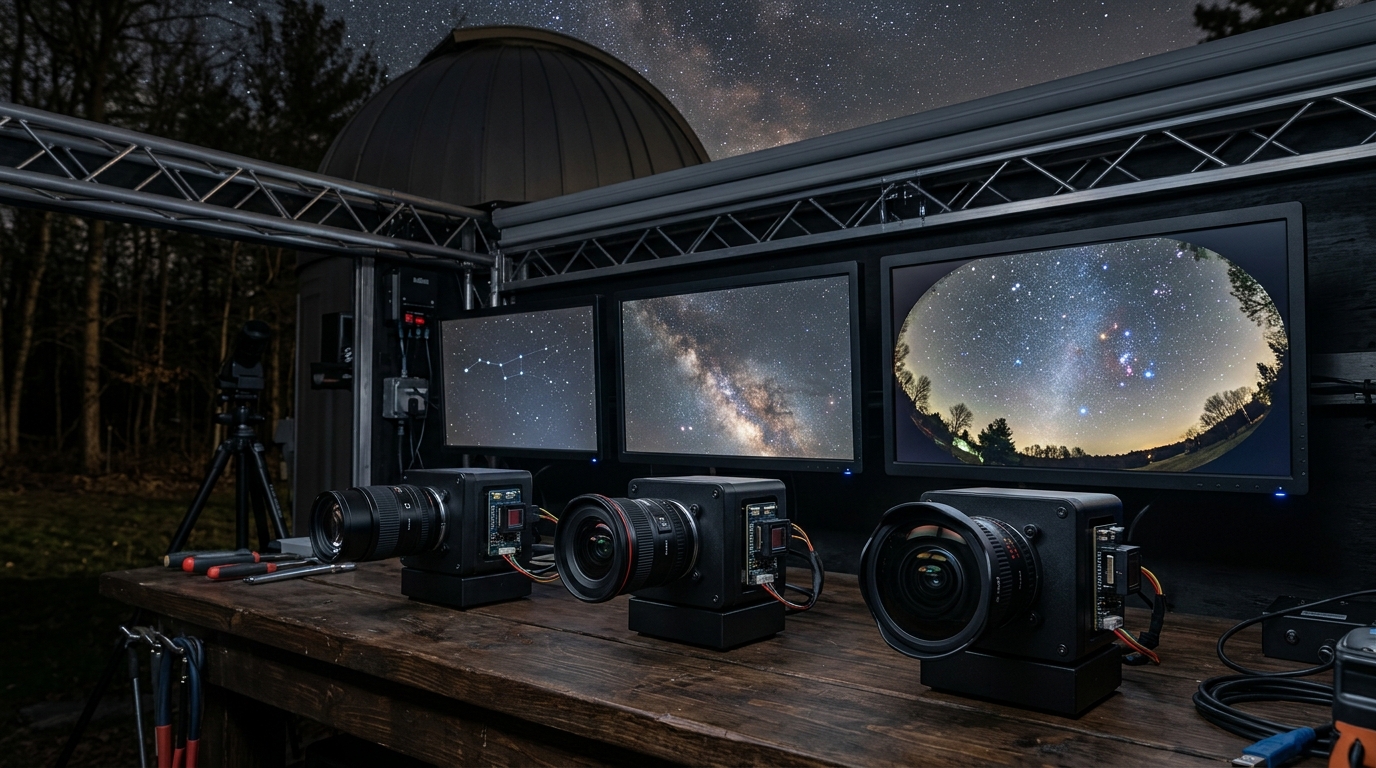
Choosing the right wide angle lens can make or break your night sky photography. The difference between a mediocre shot and a stunning Milky Way capture often comes down to lens performance at wide apertures, coma control, and how well the glass handles point light sources across the frame.
The best wide angle lens for astrophotography balances fast apertures (f/2.8 or wider), minimal coma in corners, and sharp star rendering across the frame. Popular choices include the Sigma 14mm f/1.8 Art for full frame shooters and the Rokinon 12mm f/2.0 for crop sensors. Budget matters less than optical performance at maximum aperture, where most night sky work happens.
What Makes a Lens Great for Night Sky Photography
Not every wide angle lens performs well under stars.
You need fast glass. An f/2.8 aperture is the minimum for serious work. Faster is better. An f/1.8 or f/1.4 lens gathers significantly more light, letting you use shorter exposures before star trailing becomes visible.
Coma is your enemy. This optical aberration turns point light sources into tiny comet shapes, especially in frame corners. Budget lenses often show severe coma wide open, forcing you to stop down and lose light gathering ability.
Sharpness matters differently at night. Center sharpness is less critical than corner to corner consistency. Stars occupy the entire frame, so edge performance counts more than daytime landscape work.
Manual focus is often preferable. Autofocus struggles in darkness anyway. Many astrophotographers prefer lenses with hard stops at infinity and smooth focus rings for precise adjustments.
Top Lens Options by Sensor Size
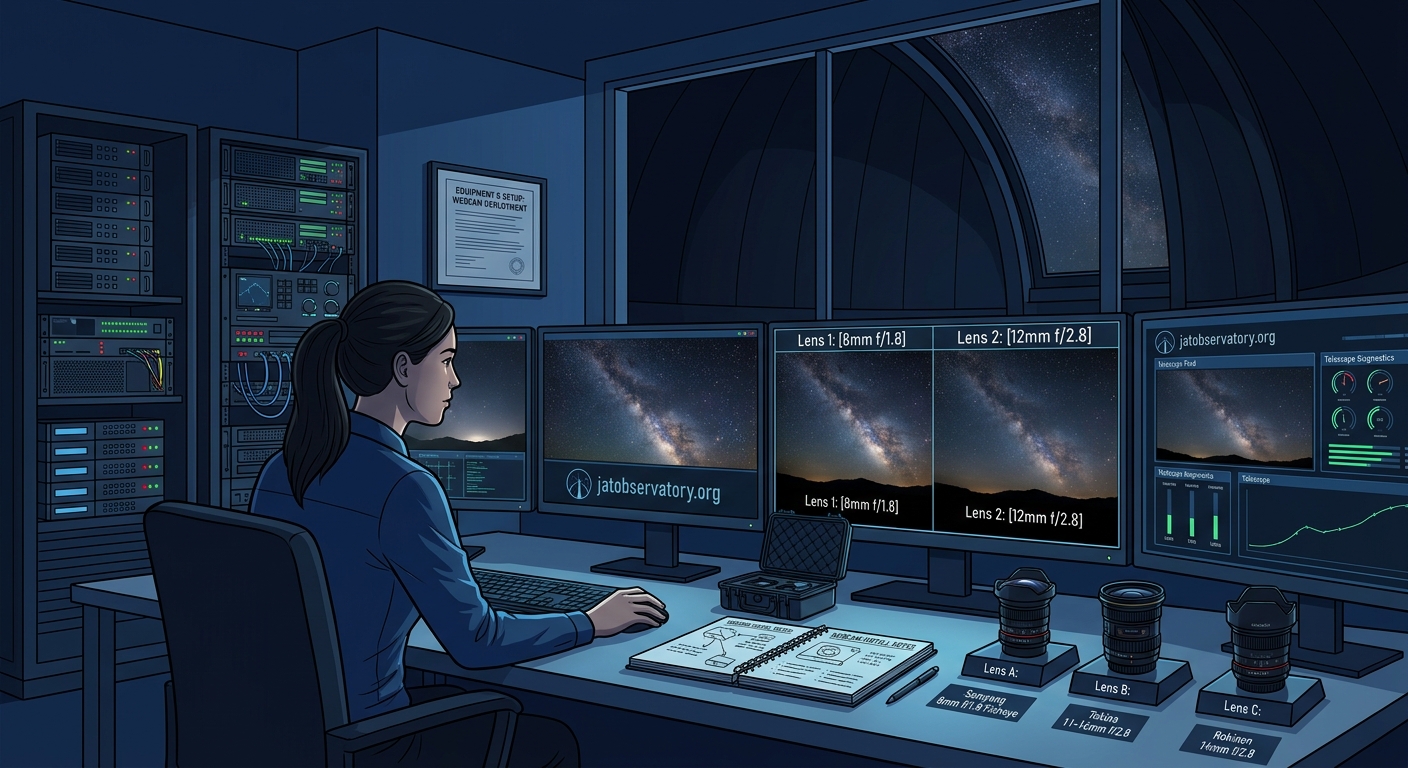
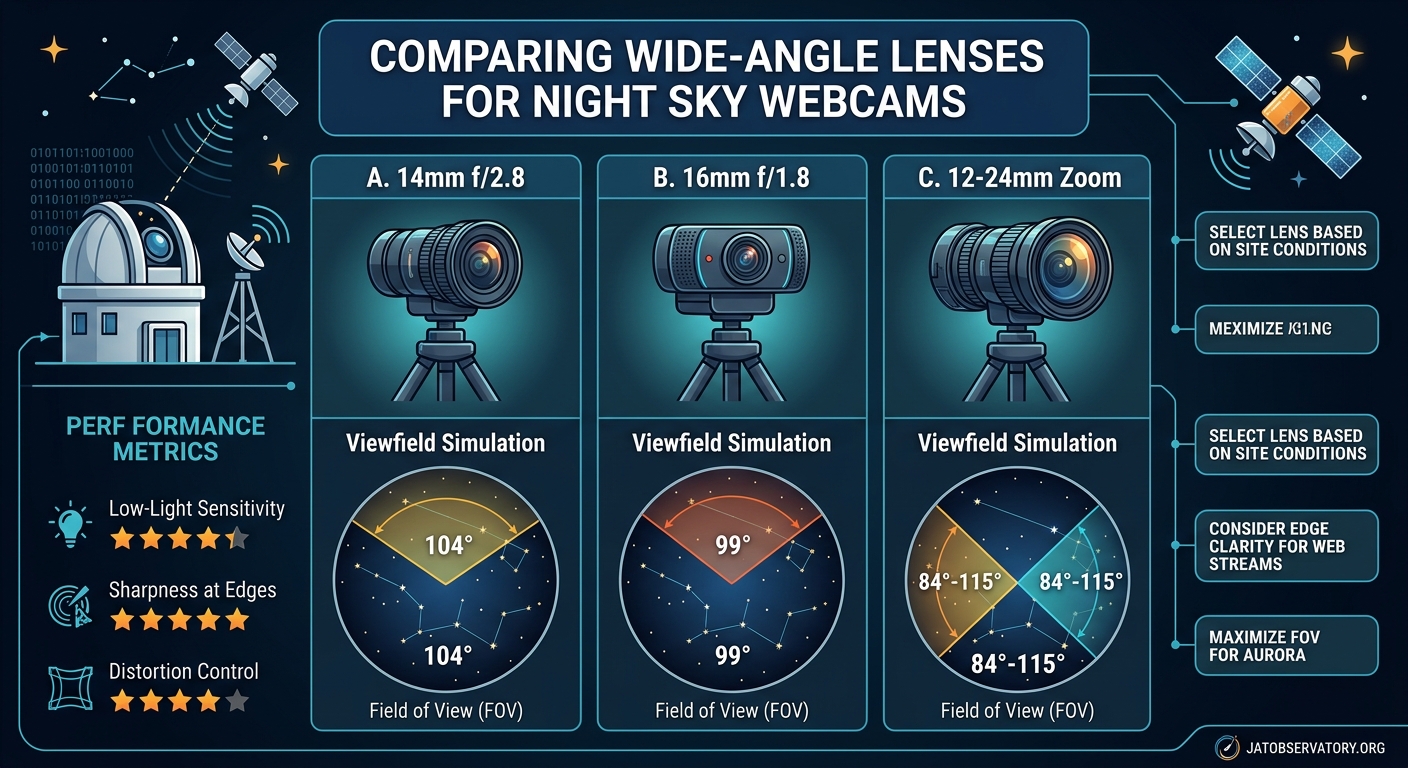
Different camera formats need different focal lengths to achieve similar fields of view.
Full Frame Choices
The Sigma 14mm f/1.8 DG HSM Art delivers exceptional performance. It stays sharp corner to corner even wide open. Coma is well controlled. The extra stop over f/2.8 zooms makes a real difference in exposure times.
The Sony FE 14mm f/1.8 GM offers similar performance for Sony shooters. It’s lighter than the Sigma and focuses faster, though manual focus works fine for stars.
The Rokinon 14mm f/2.8 provides budget friendly performance. Manual focus only. Some sample variation exists, but good copies perform admirably for the price.
Crop Sensor Options
The Rokinon 12mm f/2.0 NCS CS is hard to beat for APS-C cameras. It delivers roughly 18mm equivalent field of view. Sharp across the frame. Minimal coma. The price point makes it accessible for beginners.
The Sigma 16mm f/1.4 DC DN Contemporary works brilliantly on mirrorless crop sensors. Autofocus actually functions. Excellent build quality. The f/1.4 aperture helps in light polluted areas.
The Tokina 11-16mm f/2.8 offers zoom flexibility. Constant f/2.8 aperture. Good for composition experimentation, though prime lenses typically outperform zooms optically.
Micro Four Thirds Solutions
The Olympus 7-14mm f/2.8 PRO covers ultra wide territory. Weather sealed. Sharp performance. The f/2.8 aperture is slower in absolute terms but sensor stabilization helps compensate.
The Laowa 7.5mm f/2.0 provides an extremely wide field. Manual focus. Compact and light. Excellent value for all sky type captures.
Performance Characteristics That Actually Matter
Specifications tell part of the story. Real world performance tells the rest.
Aperture speed directly affects your exposure triangle. An f/1.4 lens gathers four times more light than f/2.8. That means you can use ISO 3200 instead of ISO 12800, dramatically reducing noise.
Coma correction varies wildly between lenses. Test shots of star fields reveal which lenses keep stars round across the frame. Corner stars should look like points, not birds in flight.
Chromatic aberration shows up as color fringing around bright stars. Modern lenses control this better than older designs, but it still appears in some budget options.
Vignetting darkens frame corners. Some is correctable in post processing. Severe vignetting creates uneven sky backgrounds that complicate stacking and panoramas.
Here’s how common lenses compare on key metrics:
| Lens Model | Max Aperture | Corner Coma | Weight | Approximate Price |
|---|---|---|---|---|
| Sigma 14mm f/1.8 Art | f/1.8 | Minimal | 1170g | $1,600 |
| Rokinon 14mm f/2.8 | f/2.8 | Moderate | 550g | $350 |
| Sigma 16mm f/1.4 DC DN | f/1.4 | Minimal | 405g | $450 |
| Rokinon 12mm f/2.0 | f/2.0 | Low | 245g | $250 |
| Sony FE 14mm f/1.8 GM | f/1.8 | Minimal | 460g | $1,600 |
How to Test a Lens for Astrophotography
Buy from retailers with good return policies. Test immediately.
- Shoot a star field at maximum aperture with your camera on a sturdy tripod
- Focus carefully on a bright star using live view magnification at 10x
- Take multiple frames at different focus positions to ensure you hit true infinity
- Examine corners at 100% magnification for coma and sharpness
- Check for color fringing around bright stars
- Test vignetting by shooting an evenly lit surface or twilight sky
Your first real world test should happen on a clear night away from city lights. Shoot the Milky Way core if possible. The dense star field reveals optical flaws that sparse constellations might hide.
Compare your results to sample images online from the same lens. Significant variation between your shots and published reviews might indicate a decentered element or other defect worth exchanging.
“I’ve tested over forty wide angle lenses for night sky work. The single biggest mistake people make is buying based on daytime sharpness tests. A lens can be razor sharp at f/8 under sunlight but turn stars into seagulls at f/2.8 under moonlight. Always check astrophotography specific reviews before purchasing.” — experienced astrophotographer
Budget Versus Performance Tradeoffs
Expensive lenses offer measurable advantages, but diminishing returns apply.
A $1,600 Sigma 14mm f/1.8 outperforms a $350 Rokinon 14mm f/2.8. The question is whether that performance difference justifies the price gap for your work.
Consider these factors:
- Print size matters – If you’re sharing on Instagram, pixel level perfection matters less than composition and processing
- Light pollution affects needs – Dark sky sites benefit more from premium optics than suburban shooting
- Shooting style varies – Single exposures demand better performance than stacked images where you can average out aberrations
- Upgrade path exists – Starting with budget glass lets you learn before investing heavily
Many successful astrophotographers began with inexpensive manual focus lenses. They learned composition, exposure, and processing before upgrading to premium glass.
The Rokinon/Samyang lineup deserves special mention. These Korean manufactured lenses offer remarkable value. Sample variation exists, so buying from retailers who allow exchanges helps. Good copies rival lenses costing three times more.
Common Mistakes When Choosing Astrophotography Lenses
People focus on the wrong specifications.
Ignoring coma performance is the biggest error. A lens might be incredibly sharp but unusable for stars if coma is severe. Always check astrophotography specific reviews, not just general optical bench tests.
Assuming zoom flexibility helps leads to disappointment. Zoom lenses rarely match prime lens performance at wide apertures. The convenience of variable focal length matters little when you’re shooting the same 14mm or 24mm framing repeatedly.
Overlooking manual focus quality creates frustration. Some lenses have loose focus rings or no hard stop at infinity. These make precise focusing difficult in darkness.
Buying for daytime use first compromises night performance. A lens optimized for landscape photography at f/8 may perform poorly at f/2.8 where you’ll actually use it under stars.
Neglecting weight considerations matters for travel astrophotography. A 1200g lens might deliver stunning results but becomes a burden on hiking trips to dark sky locations.
Pairing Lenses with Camera Bodies
Sensor characteristics interact with lens performance.
Full frame sensors show more vignetting and corner aberrations than crop sensors using the same lens. A lens that looks great on APS-C might disappoint on full frame.
High resolution bodies reveal optical flaws invisible on lower megapixel cameras. A 45MP sensor shows coma and chromatic aberration that a 24MP sensor masks.
In body stabilization helps with framing and composition but doesn’t eliminate star trailing during actual exposures. Don’t rely on it for longer exposures.
Crop factor calculations affect your field of view planning. A 12mm lens on APS-C gives roughly 18mm equivalent coverage. On Micro Four Thirds, that same 12mm acts like 24mm.
Pairing a fast lens with a capable sensor maximizes results. Modern sensors handle high ISO remarkably well. A Sony A7S III at ISO 12800 produces cleaner images than cameras from five years ago at ISO 3200.
Practical Focal Length Selection
Wider isn’t always better for every subject.
14mm to 16mm works brilliantly for Milky Way panoramas and capturing large constellation patterns. This range fits the galactic core with room for foreground interest.
20mm to 24mm suits constellation portraits and tighter compositions. Stars appear larger. You can include specific deep sky objects with context.
35mm is the widest I’d recommend for targeted deep sky work. Beyond this, you’re better served by a tracking mount and longer focal lengths.
For building an all sky camera system to monitor celestial patterns year round, fisheye lenses around 8mm provide complete horizon to horizon coverage.
The focal length you choose affects your exposure calculations. Wider lenses allow longer exposures before star trailing becomes visible. The 500 rule (500 divided by focal length equals maximum exposure in seconds) provides a starting point, though modern high resolution sensors often require shorter times.
Adapting Lenses Across Mounts
Manual focus astrophotography lenses adapt easily between camera systems.
Simple mechanical adapters let you mount Canon EF lenses on Sony E mount bodies, Nikon F glass on Canon RF cameras, and countless other combinations. Since autofocus isn’t needed, these adapters work perfectly.
Flange distance determines what adapts to what. Short flange distances like Sony E mount and Canon RF accept almost anything. Longer flange distances like Canon EF and Nikon F limit options.
Electronic adapters add autofocus capability but cost more and add failure points. For astrophotography, the simpler mechanical adapter usually makes more sense.
This flexibility means a Rokinon 14mm f/2.8 in Canon mount works on Sony, Nikon Z, Canon RF, and Micro Four Thirds with appropriate adapters. You’re not locked into one system.
Testing Methods for Corner Star Performance
Evaluating a lens properly requires systematic testing.
Mount your camera on a solid tripod. Point at a rich star field away from the Milky Way core where individual stars are visible but numerous.
Focus carefully using a bright star. Magnify your live view to maximum. Adjust focus until the star is the smallest possible point.
Shoot at maximum aperture. Take multiple frames. This helps identify focus errors versus optical problems.
Download the images and examine corners at 100% magnification. Stars should appear round, not elongated. Color fringing should be minimal.
Compare corners to the center. Some performance drop off is normal. Severe differences indicate optical problems.
Repeat the test at f/4 to see how stopping down improves performance. This tells you if you can sacrifice some light gathering for better star shapes when conditions allow.
Lens Recommendations by Budget Category
Different price points offer different capabilities.
Under $300: Rokinon 12mm f/2.0 for crop sensors, Rokinon 14mm f/2.8 for full frame. Manual focus. Good optical performance. Sample variation requires buying from retailers who accept returns.
$400 to $700: Sigma 16mm f/1.4 DC DN for crop sensors, Tokina 11-16mm f/2.8 for flexibility. Better build quality. More consistent performance between samples.
$800 to $1,200: Sigma 14-24mm f/2.8 DG DN Art for zoom flexibility, Laowa 15mm f/2 for unique features. Professional build. Excellent optical performance.
Above $1,200: Sigma 14mm f/1.8 Art, Sony FE 14mm f/1.8 GM. Best in class performance. Minimal coma. Exceptional build quality. Worth the investment for serious work.
Used market offers excellent values. Older Rokinon versions sell for $150 to $200 and perform nearly identically to current models. Manual focus lenses age better than autofocus designs since there are fewer components to fail.
Weather Sealing and Durability Considerations
Night photography often happens in challenging conditions.
Dew formation is your primary concern. Lenses cool down rapidly under clear skies. Moisture condenses on front elements. This ruins shots and potentially damages electronics.
Dew heaters solve this problem better than weather sealing. USB powered heating strips wrap around lens barrels, keeping glass above dew point temperature.
Weather sealed lenses resist moisture intrusion but don’t prevent dew formation on external surfaces. They do protect against light rain and dusty conditions.
Build quality varies significantly. Metal construction holds up better than plastic during temperature swings. Smooth focus rings maintain feel in cold weather better than cheap mechanisms.
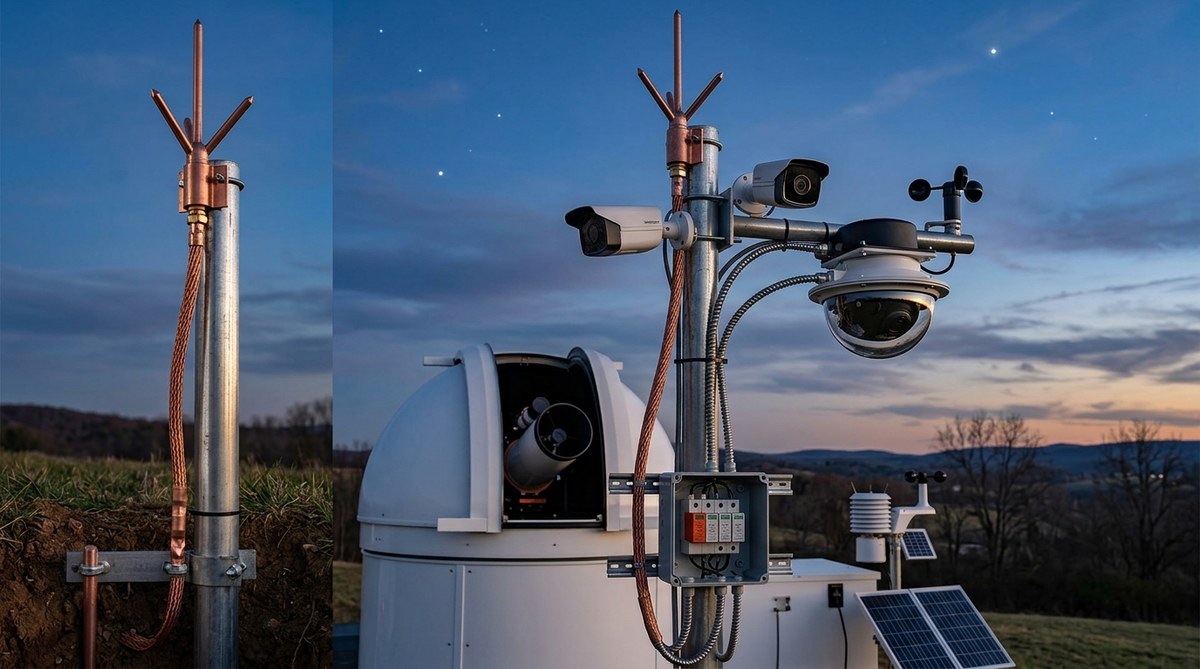
For remote observatory applications like those discussed in how to build your first remote observatory webcam system for under $300, environmental protection becomes critical. Lenses operate unattended in all weather conditions.
Processing Considerations for Different Lenses
Post processing requirements vary by lens characteristics.
Vignetting correction is straightforward in modern software. Lightroom and similar programs include lens profiles for popular models. Manual correction works fine for unrecognized lenses.
Chromatic aberration removal handles most color fringing automatically. Severe cases require manual adjustment of purple and green fringe sliders.
Coma correction is harder to fix in post. Some specialized software attempts correction, but results vary. Prevention through lens selection beats correction.
Distortion matters less for star fields than architecture. Slight barrel or pincushion distortion is barely noticeable in night sky shots.
Shooting RAW is essential. The processing latitude helps recover shadow detail and control highlights from bright stars or moonlit foreground elements.
How Lens Choice Affects Your Workflow
Different lenses create different shooting patterns.
Prime lenses force you to move and think about composition. This often produces better results than zoom convenience. You learn your focal length intimately.
Fast apertures enable shorter exposures, reducing the need for tracking mounts. You can shoot untracked at f/1.4 for 15 to 20 seconds and get sharp stars.
Manual focus slows you down initially but becomes second nature. Most astrophotographers prefer it over autofocus hunting in darkness.
Weight affects how much other gear you bring. A light lens means you can pack a second camera body, intervalometer, or extra batteries.
Your lens choice ripples through your entire kit. A heavy lens might require a beefier tripod. An expensive lens might mean delaying other purchases. A manual focus lens eliminates the need for autofocus illumination accessories.
Making Your Final Decision
Start by defining your actual shooting scenarios.
Will you hike to dark sky sites or shoot from home? Travel photography demands lighter, more compact options. Backyard work allows heavier, bulkier lenses.
What subjects interest you most? Wide Milky Way panoramas need different focal lengths than constellation portraits or photographing the Andromeda Galaxy from a suburban backyard observatory.
How much light pollution do you face? Dark sites benefit more from premium optics. Light polluted areas might see better returns from filters and processing than expensive lenses.
What’s your skill level? Beginners often benefit more from learning composition and processing with budget glass than buying premium lenses before mastering fundamentals.
Consider renting before buying. Many camera stores and online services rent lenses for reasonable daily rates. Test your top choices under real conditions before committing.
Read reviews from astrophotographers, not just general photography sites. Daytime performance doesn’t predict night sky results. Look for reviews showing actual star field images at maximum aperture.
Finding the Right Glass for Your Night Sky Journey
The best wide angle lens for astrophotography is the one that matches your actual shooting style, budget, and performance needs.
Premium options like the Sigma 14mm f/1.8 Art deliver measurable advantages in coma control and light gathering. Budget choices like the Rokinon 12mm f/2.0 provide remarkable value for photographers still learning the craft.
Your camera sensor size determines which focal lengths work best. Crop sensors need shorter focal lengths to achieve similar fields of view as full frame bodies.
Test methodically before committing. Shoot star fields at maximum aperture. Examine corners carefully. Compare results to published samples.
Remember that great astrophotography comes from understanding exposure, composition, and processing more than owning the most expensive gear. Start with what you can afford. Learn your lens thoroughly. Upgrade when your skills outpace your equipment’s capabilities.
The stars will still be there when you’re ready for that next piece of glass.

Post Comment