How to Align Your Remote Observatory Camera with the 2026 Astrological Houses
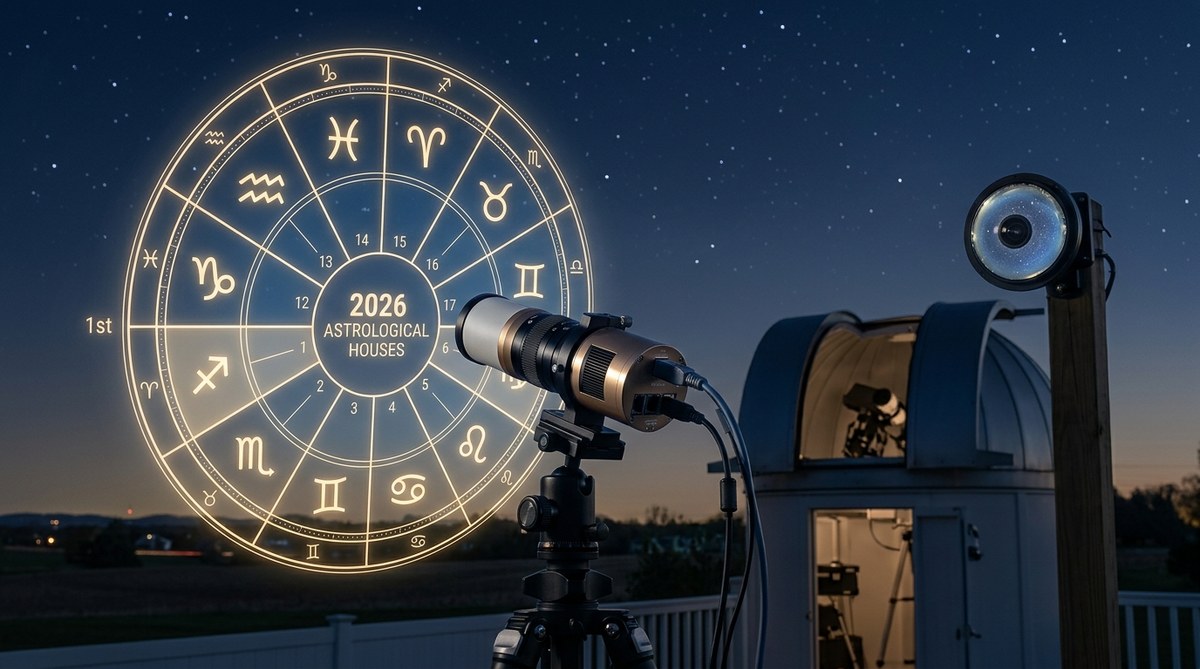
You have spent months dialing in your remote observatory. The mount is polar aligned. The autofocus routine runs without a hitch. But when you plate solve a target, the framing is off by a degree or more. That drift might not matter for a wide field shot of the Milky Way. It matters a lot when you are trying to place Jupiter exactly at the cusp of the 10th house during a 2026 conjunction. If you want to capture celestial events with astrological precision, your camera alignment needs to match the coordinate systems used by house division calculations.
Aligning your remote observatory camera for astrological house photography in 2026 requires more than a good polar alignment. You need to synchronize your camera’s rotation angle with the ecliptic coordinate system, calibrate plate solving routines to recognize house cusps, and account for precession drift. This guide walks you through the technical steps to lock in that alignment.
Why Camera Rotation Matters for House Division Photography
Most deep sky imagers think about camera angle only in terms of framing a nebula or galaxy. When you add astrological house divisions into the workflow, rotation becomes a critical variable. House systems like Placidus or Whole Sign depend on the precise intersection of the ecliptic with the local horizon and meridian. If your camera sensor is rotated even a few degrees off from the ecliptic plane, the house cusps in your image will not match the calculated positions.
Think of it this way. Your mount tracks in equatorial coordinates. Your plate solver translates those into RA and Dec. But house divisions are calculated in ecliptic coordinates with a specific obliquity value for the epoch. If you are shooting in March 2026, the obliquity of the ecliptic is about 23.44 degrees, but it changes slowly. Your camera needs to be oriented so that the long axis of the sensor aligns with the ecliptic latitude lines for the region of sky you are targeting.
Understanding the Three Coordinate Systems You Need to Merge
Before you touch a single thumbscrew, get comfortable with how these three grids overlap.
- Equatorial (RA/Dec): Your mount and plate solver live here. The celestial equator is the reference plane.
- Ecliptic (Celestial Longitude/Latitude): This is the Sun’s apparent path. House divisions are measured along this plane. The ecliptic is tilted about 23.5 degrees from the equator.
- Local Horizon/Altitude-Azimuth: The observer’s sky. House cusps are defined by the intersection of the ecliptic with the local meridian and horizon.
Your goal is to align your camera sensor’s pixel grid so that one axis runs parallel to ecliptic latitude lines for the field of view you are imaging. That way, when you plate solve and then overlay house cusp lines, the geometry is correct without distortion.
A Step-by-Step Process to Lock In Alignment
Here is a repeatable workflow you can run at the start of each observing season. Do this during twilight or with a bright star field so your plate solver has enough reference points.
-
Slew to a star near the ecliptic at your target’s hour angle. Choose a star within 5 degrees of the ecliptic plane. For 2026 planning, Regulus (in Leo) works well for spring evenings. Altair (in Aquila) is good for summer.
-
Take a test image and plate solve it. Use ASTAP, PlateSolve 2, or ASTROMETRY.NET. Note the rotation angle reported by the solver. This is the angle of your sensor relative to equatorial north.
-
Calculate the ecliptic offset for your target’s RA. The ecliptic is not constant across the sky. At the vernal equinox point (0h RA), the ecliptic is tilted about 23.44 degrees east of north. At 12h RA, it tilts the opposite way. Use a tool like PyEphem or the Skyfield library to get the ecliptic position angle at the center of your field.
-
Rotate your camera to match. Subtract the ecliptic position angle from your current plate solved rotation. The difference is how many degrees you need to rotate the camera. Most remote setups let you adjust rotation via a motorized rotator or a manual adapter. If you are using a manual setup, mark your starting position and rotate incrementally.
-
Re-image and plate solve again. Confirm the new rotation angle brings your sensor closer to the ecliptic parallel. You want the long axis of the sensor to be within 0.5 degrees of the ecliptic latitude line for your target.
-
Save this rotation as a preset. In NINA, SGP, or Voyager, store the rotator angle as a profile for that specific target. If you are shooting multiple house positions across the year, create separate profiles.
Common Mistakes That Wreck Alignment
Even experienced observers slip up on these. Here is a table of the most frequent errors and how to avoid them.
| Mistake | What Happens | Fix |
|---|---|---|
| Using the wrong epoch | House cusps are calculated for J2000 or B1950. Your plate solver might use JNow. The difference can be 0.5 degrees or more. | Force your planetarium software to use JNow for house calculations, or convert your solver to match the epoch of your astrological chart. |
| Ignoring precession for 2026 | Precession shifts the equinox about 1.4 degrees per century. Since J2000, the shift is about 0.36 degrees. That matters for cusp placement. | Use a precession correction routine in your scripting. Most Python astrometry libraries have a built in precess function. |
| Rotating the camera after polar alignment | A change in camera rotation can subtly shift the optical axis on some telescopes, especially with heavy filter wheels. | Always do your final rotation adjustment after polar alignment is locked. Recheck polar alignment if you rotate more than 10 degrees. |
| Not accounting for field curvature | Wide field refractors can show field rotation at the edges that is not uniform. | Use a smaller subframe for plate solving, or solve on a star near the center of the field. |
Tools and Scripts to Automate the Alignment
You do not want to manually calculate ecliptic offsets every night. Here are three approaches that work well for remote setups.
-
NINA with the Ecliptic Coordinate Plugin: NINA has a community plugin that can display ecliptic grid lines on the framing panel. Slew to your target, enable the grid, and rotate your camera until the grid lines are parallel to the sensor edges. It is visual and immediate.
-
Python script with Skyfield and ASTAP: Write a script that takes your target coordinates, calculates the ecliptic position angle at the field center, and then sends a rotation command to your motorized rotator via ASCOM. This is fully automated and repeatable.
-
Manual reference stars method: Create a list of bright stars that lie exactly on the ecliptic for each month of 2026. Use those stars as your alignment reference. Slew to the star, plate solve, rotate, and lock. This is the most reliable method if you do not trust software.
Expert advice: “I have been aligning remote observatories for seven years. The single biggest improvement I made was switching from visual framing to automated ecliptic alignment. It cut my setup time by 20 minutes per session and eliminated the frustration of finding my house cusps off by half a degree.” — JAT Observatory engineering lead.
What to Do When Plate Solving Fails
Sometimes the solver cannot find a match because the field is too sparse or the rotation is too far off. Here are your fallback options.
- Use a synthetic field. Generate a synthetic star field that matches your expected rotation and plate solve against that. The ASCOM standard includes a method for this.
- Switch to a brighter star field. Slew to a dense Milky Way field near your target, solve there, then slew back. Your mount’s pointing model should hold the rotation.
- Manually align with a reticle eyepiece. If you have a remote setup with a flip mirror, insert a crosshair eyepiece and rotate until a known star tracks along the ecliptic line. This is old school but it works.
Building Your 2026 Observation Calendar Around House Alignments
Once your camera is aligned, you can plan your sessions around specific house transits. For example, if you want to capture the Moon passing through the 8th house during a 2026 lunar eclipse, check the house cusp times for your location. Set your sequence to start 30 minutes before the cusp and run until 30 minutes after. Your aligned camera will capture the Moon’s path relative to the house boundaries with sub arcminute accuracy.
If you are interested in how house divisions interact with planetary conjunctions, read our guide on how planetary alignments actually look through a backyard telescope. For a broader look at automating your setup, see how to automate your backyard observatory with open-source software.
Keeping Your Alignment Stable Through the Year
Temperature changes, cable snags, and mount slews can all knock your rotation off. Build these checks into your routine.
- Check rotation after every meridian flip. The mechanical load shifts, and the camera can rotate slightly. Add a plate solve and rotation verification step in your sequence after the flip.
- Monitor with an all-sky camera. Your all-sky camera can show if the telescope has moved relative to the pier. A sudden change in the telescope’s silhouette means something shifted.
- Use a rotation sensor. Some motorized rotators include an encoder. Log the encoder value at the start of each session and compare it to the previous value. If it changed, you know something moved.
Aligning for Multiple House Systems in One Night
If you are imaging targets that cross multiple house cusps, you might need to adjust rotation slightly for each segment. The ecliptic position angle changes as you move in RA. For a two hour sequence covering 30 degrees of RA, the ecliptic angle can shift by about 1 degree. That is enough to throw off cusp alignment for high precision work.
The solution is to break your sequence into segments. Run a plate solve and rotation correction before each segment. Your automation software can handle this. Just set the tolerance to 0.3 degrees and let it correct automatically.
Bringing Precision to Your 2026 Astrological Astrophotography
Aligning your remote telescope camera to the ecliptic is not a set it and forget it task. It is a seasonal calibration that pays off every time you capture a transit, conjunction, or eclipse exactly where your chart says it should be. The 2026 sky has several events worth the effort, including a Venus-Jupiter conjunction in the 10th house and a total lunar eclipse crossing the 8th house for many US locations.
Take the time this month to run through the alignment process. Mark your rotator positions. Save your profiles. Test with a few bright stars. Once you see your first plate solved image with house cusp lines matching the sensor grid, you will wonder why you did not do this sooner. The night sky is waiting, and your camera is ready to capture it with astrological accuracy.

Post Comment