Planning Your Observatory Sessions Around Solar Timing and the Zodiac
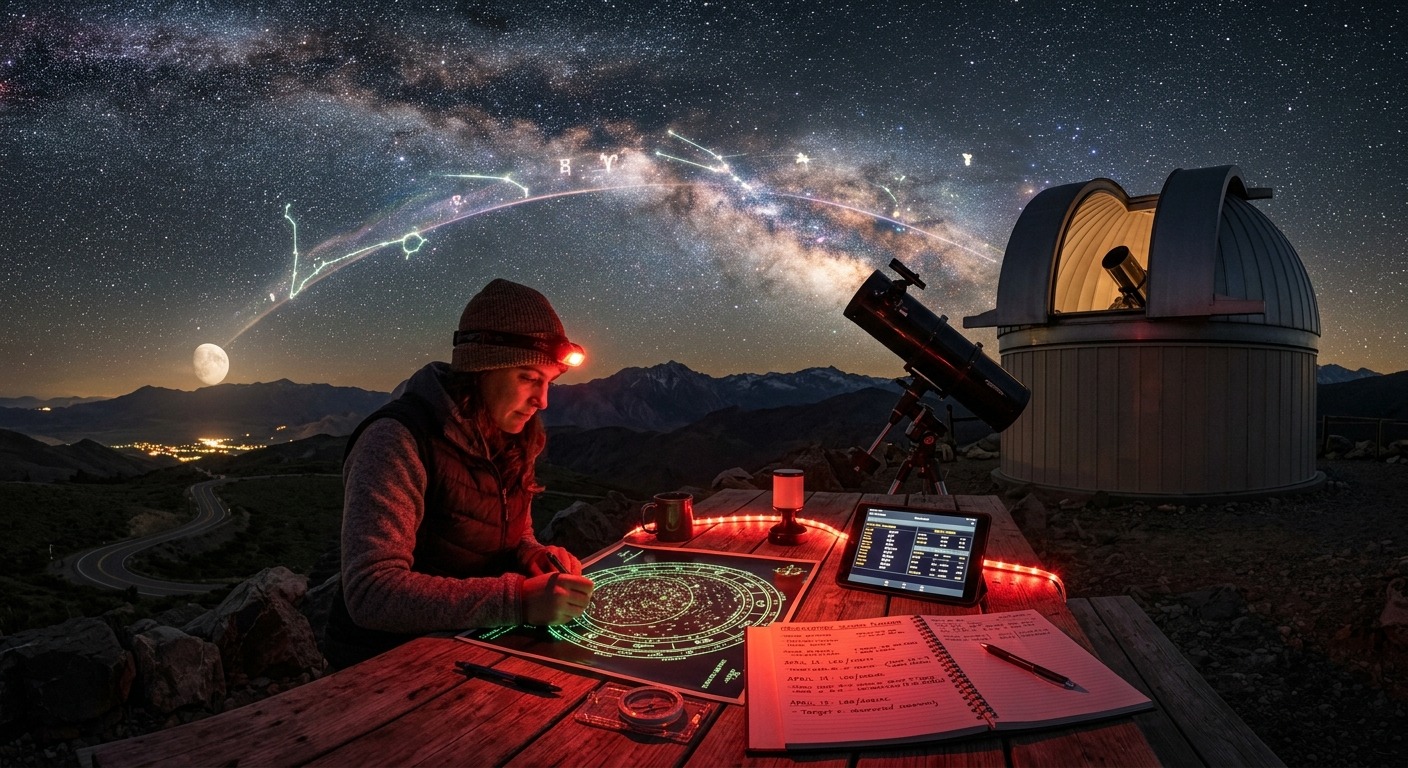
The sun is the single biggest variable in every observing session you will ever run. It controls when your sky goes dark, how long you have before dawn threatens your imaging run, and which constellations are positioned favorably for the camera. Get your solar timing right, and your whole scheduling workflow clicks into place. Get it wrong, and you are either burning time waiting for twilight to pass or scrambling to close up before morning washes out your data.
Session Planner’s Snapshot
Reliable observatory automation starts with understanding the sun’s daily arc, not just a rough sunset time. Astronomical twilight windows, solar elevation triggers, and seasonal daylight shifts all feed into a scheduling routine that opens your dome at exactly the right moment and closes it before morning light can damage your data. Layering the zodiac calendar on top connects your practical workflow to the interpretive sky-watching that makes each season’s observing window feel distinct.
Why the Sun’s Daily Arc Controls Your Observatory Window
Most casual stargazers think of sunset as the starting gun for a night at the telescope. For anyone running a remote observatory, actual usable darkness begins much later, and it ends sooner than you expect. The sun’s path through the sky is a continuous arc, not a simple on-off switch. From the moment it dips below the horizon, scattered sunlight keeps the sky too bright for serious deep-sky work. That gradient of brightness, tied directly to the sun’s angle below the horizon, is the real variable you need to track.
Your observing window is essentially a gap between two twilight events. One opens in the evening, and the other closes in the morning. The width of that gap changes every single night. In midsummer at mid-northern latitudes, it can compress to a narrow two-hour slot. In the depths of winter, it stretches past eight hours. If your roof or dome automation is pegged to a fixed clock time, you are either missing imaging time or risking your equipment depending on the season. Solar position is a far better trigger than any static schedule.
Understanding the Three Twilight Phases
Twilight does not come in one flavor. Astronomers divide it into three distinct phases, each defined by the sun’s angle below the geometric horizon. That angle is called solar depression, and knowing it precisely is the foundation of any solid observatory scheduling routine.
Civil twilight is the shallowest phase, covering the period when the sun sits between zero and six degrees below the horizon. The sky is still well-lit, and the brightest planets may just be visible. No serious deep-sky imaging happens here. Nautical twilight follows, running from six to twelve degrees of solar depression. The sky retains a fading glow on the western horizon, and faint nebulae are still washed out, but navigation stars become visible to the naked eye. The third phase, astronomical twilight, runs from twelve to eighteen degrees below the horizon. This is where conditions start to approach genuine darkness. Once the sun drops past eighteen degrees, the sky is considered astronomically dark, and your session can run at full sensitivity.
The transition from nautical to astronomical twilight is particularly important for astrophotographers using narrowband filters. Hydrogen-alpha imaging can sometimes tolerate the later stages of nautical twilight, which can add fifteen to twenty minutes of productive time at each end of your window. Knowing exactly when those transitions happen at your specific coordinates is not guesswork. You need actual solar elevation data tied to your location.
Twilight Phase Reference for Observatory Planning
| Twilight Phase | Solar Depression Angle | Sky Condition | Imaging Suitability |
|---|---|---|---|
| Civil Twilight | 0° to 6° below horizon | Bright, well-lit sky | Planetary imaging only |
| Nautical Twilight | 6° to 12° below horizon | Fading glow, bright stars appear | Narrowband possible near end |
| Astronomical Twilight | 12° to 18° below horizon | Near dark, faint horizon glow | Wide-field broadband usable |
| Astronomical Dark | 18°+ below horizon | True night sky | All imaging modes optimal |
How Seasonal Shifts Reshape Your Observing Hours
The sun does not travel the same arc every day. Its path shifts throughout the year as Earth moves along its orbit. In winter, the sun rises and sets farther south along the horizon and climbs to a lower maximum elevation at noon. That shallower daytime arc means it drops below the horizon at a steeper angle in the evening, reaching astronomical twilight faster after sunset. Many northern observers gain their longest dark windows between November and February precisely because of this geometry.
Summer flips that dynamic entirely. The sun rides high and sets far north of west, then follows a shallow path below the horizon. In Pennsylvania, where JAT Observatory is based, mid-June nights may never reach true astronomical darkness at all. The sun simply does not sink far enough. This is not a problem unique to extreme latitudes. Anyone above roughly 45 degrees north will feel this squeeze during peak summer months. Planning your summer sessions around narrowband imaging targets is the standard workaround, since those filters cut through residual sky glow far better than broadband setups can manage.
The practical takeaway is that your automation triggers should not be hard-coded to a time of year that no longer applies. Reviewing your sunrise and sunset offsets each month takes about five minutes and keeps your system properly calibrated across the seasons. The difference between a well-timed session and one that starts thirty minutes late can mean the difference between completing a full mosaic panel or cutting it short and losing the data.
Getting Accurate Solar Position Data for Your Location
The starting point for any reliable schedule is precise local solar data. Generic sunrise and sunset tables published for broad regions are not good enough when your observatory sits at a specific latitude and longitude. Elevation, local horizon obstructions, and even your software’s definition of sunset can shift your actual darkness onset by several minutes. Whether the software measures the center of the solar disk or its leading edge crossing the horizon makes a subtle but real difference in your trigger timing.
For day-to-day session prep, bookmarking a dedicated tool that pulls real ephemeris data for your coordinates is a habit worth forming. When you need to verify twilight end times, solar elevation at a specific clock time, or how far the sun will sink below the horizon by midnight, checking your location’s sun reference data gives you precise figures rather than rounded approximations. That precision matters most during transition months like March and September, when your dark window is shifting by two to four minutes per day and your fixed-time triggers quietly fall out of sync with the actual sky.
Coordinate accuracy also feeds directly into your automation software. A location entry that is off by even a fraction of a degree can push your calculated twilight end by a minute or two. At mid-northern latitudes during autumn, that kind of drift accumulates across a season and slowly desynchronizes your automated open and close sequences from actual sky conditions. Getting the numbers right at the source prevents those small errors from compounding into sessions that miss their window entirely.
Automating Your Dome or Roof with Solar Position Triggers
Once you have reliable solar data, the next step is wiring it into your automation software. Most modern observatory control platforms, including Sequence Generator Pro, N.I.N.A., and ACP, support horizon-based triggers that reference solar elevation rather than clock time. This is a fundamentally better approach. The sky does not care what time it is. It cares where the sun sits.
A common configuration opens the roof or dome when the sun reaches a solar elevation of minus eight to minus ten degrees, which typically falls in the middle of nautical twilight. The mount can slew to a meridian flip target or begin a flat-field sequence while the sky continues to darken. Full imaging sequences then begin once the software confirms solar elevation has dropped past minus eighteen degrees. Morning automation runs the same logic in reverse, triggering a park-and-close sequence when the sun climbs back to that threshold in the pre-dawn sky.
The mathematical models powering these calculations have a long pedigree in government science. The NOAA Solar Calculator, which handles solar position calculations for any coordinate on Earth, uses the same underlying algorithms that drive observatory automation platforms. Understanding where those numbers come from builds confidence in your trigger setup and helps you troubleshoot when a sequence fires at an unexpected time of year.
The advantage of solar elevation triggers is that they self-correct across every night of the year without manual input. A session in late October opens and closes at the right time automatically, even though those times look completely different from a session in late April. Your equipment protects itself. Your data captures cleanly. The only maintenance required is verifying the ephemeris figures periodically and confirming your software is reading your location correctly.
One refinement worth adding is a cloud-abort layer on top of the solar trigger. Solar position tells you when darkness arrives, but it says nothing about weather. Pairing solar elevation triggers with an all-sky camera and a cloud sensor creates a two-condition gate. The system opens only when the sky is both dark enough and sufficiently clear. That combination forms the foundation of a truly reliable remote session, one that can run without supervision through the night.
Reading the Sky Through the Zodiac Lens
The sun’s path through the sky over the course of a year traces through the twelve constellations of the ecliptic. Each constellation corresponds to one of the zodiac signs, and for roughly thirty days the sun occupies that region of sky before moving on. From an observing standpoint, this means the sun’s zodiac position tells you something immediately practical: which part of the sky is currently too close to the sun for nighttime imaging, and which regions are riding high at the opposite end of the sky in prime position.
When the sun sits in Gemini during late May and June, the rich star-forming regions of Gemini and Taurus are lost in its glare. Sagittarius and Scorpius are perfectly placed in the summer sky, riding high in the south during the shorter nights. When the sun moves into Sagittarius in late November and December, that galactic core region disappears from the evening sky, but Orion and the surrounding winter constellations come into prime position for long, dark imaging runs.
Spring brings the Virgo galaxy cluster and the Leo Triplet to prominence as the sun moves through Aries and Taurus. Summer nights, despite being shorter, reward patience with the Cygnus and Sagittarius star fields loaded with hydrogen-alpha targets. Autumn pushes Perseus, Andromeda, and the great autumn galaxies to center stage as the sun crosses Virgo and Libra. Winter, with its long dark hours, delivers Orion, Auriga, and the Rosette Nebula to any observer willing to watch the forecast and wait for clear skies.
The astrological tradition has always tied these seasonal cycles to themes of renewal, harvest, transformation, and rest. Whether or not you take those interpretive layers literally, there is something genuinely satisfying about aligning your observing calendar with the rhythms the sky is already tracing. Your sessions become part of a larger pattern rather than isolated data captures. The zodiac gives you a narrative framework that sits directly on top of the practical geometry, and both layers are describing the same thing: where the sun is, and what that means for tonight’s sky.
Where Solar Science and the Zodiac Calendar Converge
Building a scheduling routine around the sun’s position is not a one-time setup task. It is an ongoing relationship with the sky. The sun’s arc shifts nightly. Your available dark window grows and shrinks across the seasons. The zodiac moves the prime targets around the sky in a slow, predictable cycle that rewards forward planning. Tying all of that together through accurate ephemeris data, well-configured solar elevation triggers, and a target calendar anchored to the ecliptic turns a remote observatory from a piece of equipment into a genuinely responsive observing system.
The observers who get the most from their setups are the ones who treat the sun not as an obstacle to be waited out, but as the central timekeeper of the entire sky. Its position at any given moment tells you how dark the sky is, which objects are rising into prime position, and which season of the zodiac is framing the night. Read that position correctly, and the rest of your session planning follows naturally. Every clear night becomes a well-timed window into a sky that is already telling you exactly what to look at next.

Post Comment