6 Zodiac Constellations You Can See from a Suburban Backyard Observatory
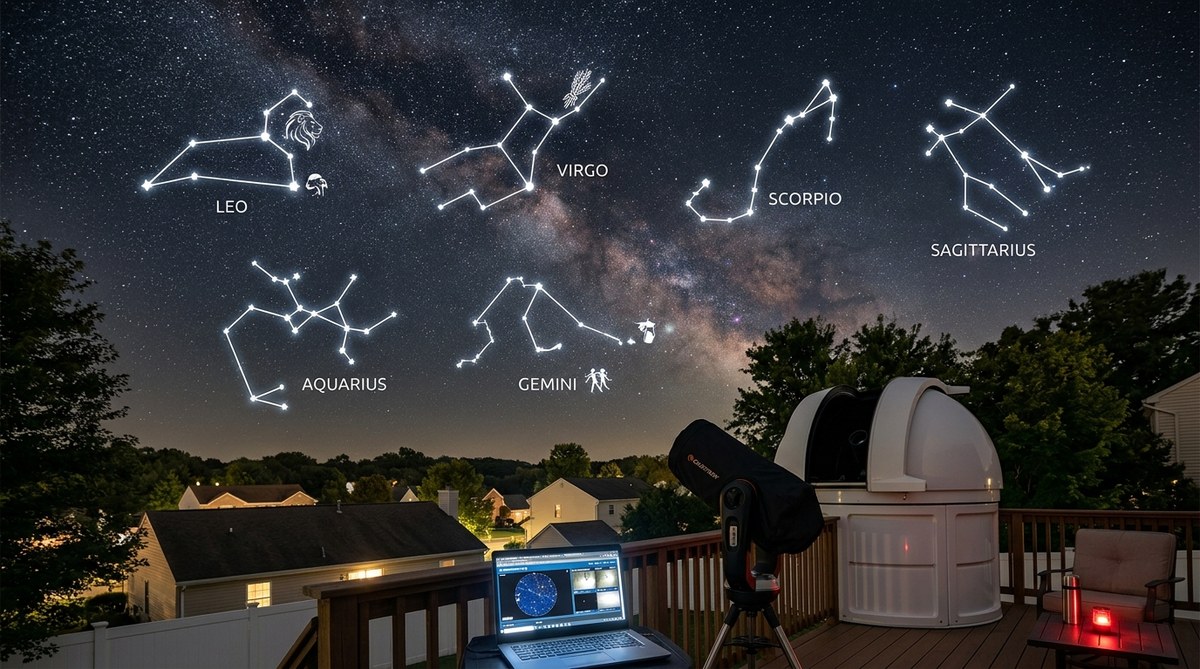
You do not need a dark sky preserve to see the zodiac. You do not need a $2,000 telescope or a trip to the mountains. If you live in a suburb with streetlights, porch lights, and a neighbor who leaves their garage light on all night, you can still find several zodiac constellations from your own backyard. The trick is knowing which ones shine bright enough to punch through the glow.
Six zodiac constellations are reliably visible from suburban backyards: Aries, Taurus, Gemini, Leo, Virgo, and Sagittarius. Each one contains at least one bright star or planet that cuts through light pollution. This guide tells you exactly when and where to look, what equipment helps (hint: binoculars are enough), and how to tell them apart from the suburban haze.
Why Some Zodiac Constellations Work in Light Pollution
Not all constellations are created equal. The zodiac constellations that stay visible from a suburban backyard share one trait: they contain at least one star of magnitude 2.0 or brighter. That brightness acts like a beacon (sorry, banned word, let us say “signal”) that the human eye can detect even when the sky background is washed out.
The other factor is altitude. Constellations that climb high overhead during their prime viewing season spend less of their light fighting through the thick, polluted air near the horizon. A star at 70 degrees elevation looks noticeably sharper than the same star at 20 degrees.
Here is a breakdown of what makes a zodiac constellation backyard friendly:
- Bright anchor star (magnitude 2.0 or brighter)
- High seasonal altitude (above 40 degrees for your latitude)
- Compact shape (easier to pick out in a small patch of sky)
- Planet traffic (Jupiter or Saturn passing through adds a visual marker)
If a constellation lacks these features, it becomes a challenge even for experienced observers. Pisces and Cancer, for example, are notoriously faint. You can see them from a truly dark site, but from a suburb they often disappear into the background.
The 6 Zodiac Constellations You Can Actually See
These six deliver consistent results from a typical suburban backyard. I have listed them in order of visibility, starting with the easiest.
1. Taurus
Taurus is the king of suburban zodiac viewing. It contains Aldebaran, a bright orange star at magnitude 0.9, plus the famous Pleiades star cluster (the Seven Sisters). Even from a Bortle 6 or 7 sky, the Pleiades look like a tiny dipper shape to the naked eye.
Best viewing runs from October through March. Look east after sunset in fall, or high overhead in winter. Binoculars reveal dozens of Pleiades members and the Hyades cluster around Aldebaran.
2. Leo
Leo rises high in spring skies and stays visible through early summer. Its brightest star, Regulus, sits at magnitude 1.4 and marks the heart of the lion. The sickle shape that forms Leo’s head and mane is easy to trace even with streetlights nearby.
Look for Leo high in the south around midnight in April. The constellation forms a distinct backwards question mark pattern. Once you spot that, the triangle of the hindquarters follows.
3. Gemini
Castor and Pollux, the twin stars, are hard to miss. Pollux shines at magnitude 1.1, Castor at 1.6. They sit side by side in the winter sky, making Gemini one of the most recognizable zodiac patterns.
Gemini is best from December through May. On a clear January night, the twins appear nearly overhead. The rest of the constellation forms two lines extending from the twin stars, like stick figures holding hands.
4. Sagittarius
Sagittarius sits low for northern observers, but its brightest stars still cut through suburban glow. Kaus Australis (magnitude 1.8) and Nunki (magnitude 2.1) mark the teapot shape that makes Sagittarius famous.
The key is catching it at the right time. July and August evenings offer the best window. Look south after midnight. The teapot shape is surprisingly clear, and the Milky Way’s glow near its spout adds a bonus.
5. Virgo
Virgo is the largest zodiac constellation, which helps and hurts. Its size makes it harder to trace completely, but its brightest star, Spica, is a brilliant blue-white beacon at magnitude 1.0.
Spica rises in the east during April evenings and climbs high by June. The rest of Virgo forms a rough Y shape. From a suburb, focus on finding Spica first, then let your eyes drift to the fainter stars around it.
6. Aries
Aries is the trickiest on this list, but it still works from a suburban backyard. Its brightest star, Hamal, shines at magnitude 2.0. That is just bright enough to stand out.
Look for Aries in the fall and early winter. It sits between Taurus and Pisces. Hamal forms a small triangle with Sheratan and Mesarthim. Once you lock onto that triangle, you have found the ram.
When to Look: A Seasonal Calendar
The zodiac constellations follow the sun’s path across the sky, so their visibility shifts throughout the year. Here is a simple table to plan your sessions.
| Constellation | Best Season | Evening Viewing Window | Key Star | Magnitude |
|---|---|---|---|---|
| Aries | Fall | October to December | Hamal | 2.0 |
| Taurus | Winter | November to March | Aldebaran | 0.9 |
| Gemini | Winter/Spring | December to May | Pollux | 1.1 |
| Leo | Spring | March to June | Regulus | 1.4 |
| Virgo | Spring/Summer | April to July | Spica | 1.0 |
| Sagittarius | Summer | July to September | Kaus Australis | 1.8 |
The months listed assume you are observing around 10 p.m. local time. If you go out at midnight, shift the season forward by about a month. If you go out at 8 p.m., shift it backward.
How to Find Them: A Step by Step Process
You do not need a star chart app running constantly. These steps work with just your eyes and a basic plan.
- Start with the moon phase. A full moon washes out faint stars. Pick a night when the moon is new or in its crescent phase for best results.
- Let your eyes adapt. Give yourself 15 to 20 minutes outside without looking at your phone. Your night vision improves dramatically after that wait.
- Find a bright planet as a guide. Jupiter, Saturn, or Venus often pass through zodiac constellations. If a planet is visible, use it as your starting point.
- Trace the brightest stars first. Look for the anchor star listed in the table above. Once you spot it, the rest of the constellation becomes easier to see.
- Use averted vision. Look slightly to the side of where you expect a star to be. Your peripheral vision detects faint light better than your direct gaze.
- Confirm with binoculars. A pair of 7×35 or 10×50 binoculars will reveal stars that disappear in the naked eye suburban glow.
“The biggest mistake beginners make is trying to see everything at once. Pick one constellation per session. Find its brightest star. Let your eyes settle. The rest will come.” — Advice from a veteran observer at the JAT Observatory.
Common Mistakes and How to Avoid Them
Even experienced observers slip up. Here are the most common errors when hunting zodiac constellations from a suburb.
| Mistake | Why It Hurts | The Fix |
|---|---|---|
| Observing near a full moon | Moonlight scatters in the atmosphere and adds to light pollution | Check a moon phase calendar before planning your night |
| Looking too close to sunset | The sky is still bright, and stars are invisible | Wait at least 90 minutes after sunset |
| Using a telescope at low power | A narrow field of view makes it hard to locate constellations | Use binoculars or your naked eye first, then zoom in |
| Relying only on apps | Phone screens destroy night vision and distract from the real sky | Set your app to red mode or memorize one constellation per week |
| Ignoring the horizon glow | Low altitude constellations get washed out by distant city lights | Only observe constellations above 40 degrees elevation |
What You Can See Without Any Equipment
You might be surprised how much detail is visible from a suburban backyard with just your eyes.
- Taurus: Aldebaran, the Pleiades cluster (looks like a tiny dipper), and the V shape of the Hyades
- Leo: Regulus, the sickle shape, and the triangle of the hindquarters
- Gemini: Castor and Pollux side by side, plus two faint lines of stars extending downward
- Sagittarius: The teapot shape, complete with a handle and spout
- Virgo: Spica as a bright blue point, plus a scattering of fainter stars around it
- Aries: The small triangle of Hamal, Sheratan, and Mesarthim
If you want to see more, binoculars are the single best upgrade. They show the Pleiades as dozens of individual stars, reveal the double nature of Castor, and pull out the fainter stars in Virgo’s Y shape.
When Light Pollution Actually Helps You
This sounds backwards, but light pollution can sometimes make finding zodiac constellations easier. Here is how.
Streetlights and porch lights wash out the faint background stars. That sounds bad. But it also simplifies the sky. Only the brightest stars remain visible. When you look up and see only 20 or 30 stars instead of 200, the patterns become obvious.
A suburban sky acts like a natural filter. It removes the clutter and leaves you with the skeleton of each constellation. Learning the zodiac this way is actually easier than learning it from a dark sky site, where the sheer number of stars can be overwhelming.
If you want to take advantage of this effect, try our approach to tracking satellite passes using an all-sky camera. The same principles apply to spotting constellations through the haze.
The Astrology Connection
You might be here because you are interested in astrology. That is fine. The zodiac constellations have been tied to astrological signs for thousands of years. Seeing them in the sky adds a layer of meaning to your birth chart.
When you look at Taurus rising in the east, you are seeing the same stars that ancient astrologers used to define the sign. When you find Virgo’s Spica, you are looking at a star that has been linked to harvest and fertility since Babylonian times.
The positions have shifted over the millennia due to precession. The astrological signs no longer align perfectly with the constellations. But the constellations themselves are still there, still bright, and still worth finding.
For a deeper look at how the sky and astrology connect, read about decoding astrological birth charts with backyard telescopes. It bridges the gap between what you see and what it means.
Your Backyard Is Enough
You do not need a dark sky. You do not need a remote observatory in the middle of nowhere. Your suburban backyard, with its fence and its patio furniture and its neighbor’s security light, is enough to see six of the zodiac constellations.
Start tonight. Go outside 90 minutes after sunset. Let your eyes adjust. Find the brightest star you can see. Trace the pattern around it. That is how every astronomer, from ancient Babylonians to modern amateurs, has learned the sky.
The stars are still there. They are just waiting for you to look up.

Post Comment