Automate Your Observatory’s Focus Routine with AI-Based HFR Analysis in 2026
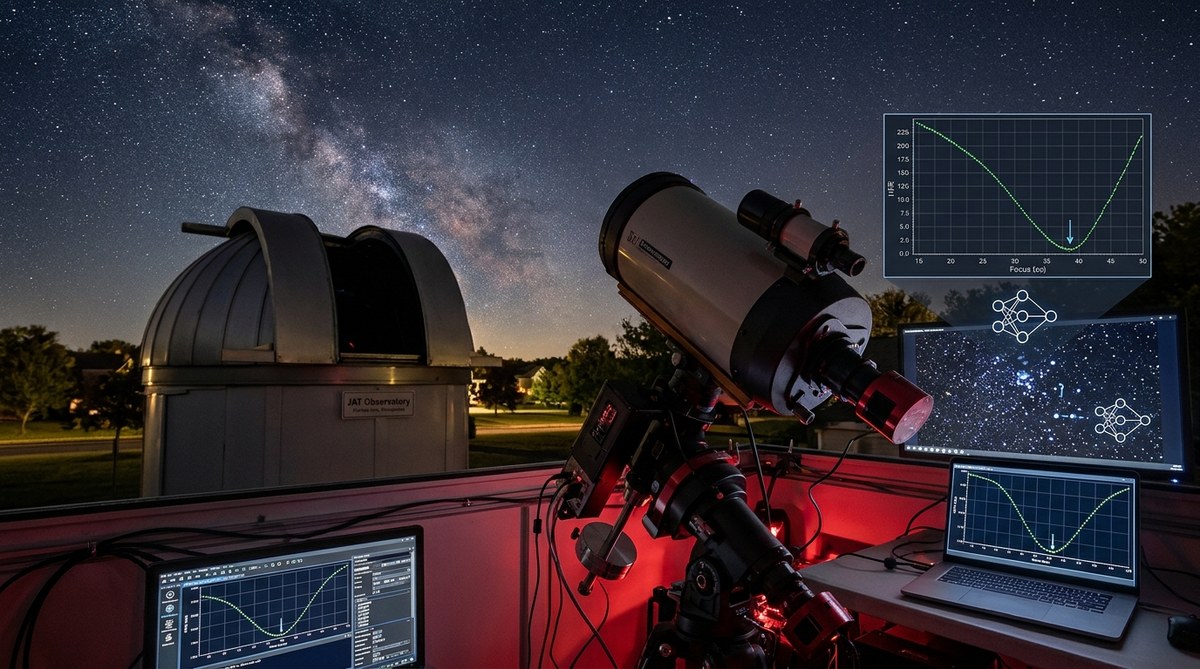
You have spent countless nights hunched over a laptop, tweaking a focus knob by tiny fractions of a millimeter. You know the frustration: a single degree drop in temperature throws your critical focus zone out the window, and suddenly an hour of precious dark sky data is ruined. Manual focusing is the single biggest bottleneck in remote observatory automation. But in 2026, that bottleneck is gone. By combining Half Flux Radius (HFR) analysis with artificial intelligence, you can build a focus routine that thinks for itself, adapts to changing conditions, and never wastes a clear night.
AI based HFR analysis observatory focus transforms how remote telescopes stay sharp. Instead of running a fixed V-curve every hour, an AI model learns how temperature, filter changes, and optical train flex affect focus. It predicts the optimal focus position before you even take a frame. This saves time, reduces data loss, and lets you sleep through the night while your observatory runs itself.
Why manual focus routines fail at 3 AM
Traditional autofocus routines work by taking a series of images at different focuser positions, measuring the HFR of each star, and fitting a V-curve to find the minimum. That process works fine when the sky is steady. But it has real problems.
First, it takes time. A typical V-curve scan can eat up three to five minutes. Do that every hour across a six hour imaging run, and you have lost almost half an hour to focusing alone. Second, it is disruptive. The telescope slews to a bright star, the filter wheel rotates, and you lose the target for several frames. Third, it is reactive. By the time the routine detects that focus has drifted, you have already collected substandard data.
AI based HFR analysis observatory focus solves all three problems. Instead of reacting to focus drift, the system predicts it. The AI learns the relationship between environmental variables and the focuser position that yields the lowest HFR. That means it can preemptively adjust the focuser before the stars go soft.
How AI learns your telescope’s focus personality
Every telescope has a unique focus fingerprint. The way your focuser responds to temperature changes depends on the materials in your optical train. Carbon fiber tubes react differently than aluminum. A heavy camera load can cause flex that shifts the focal plane as the telescope tracks across the sky.
An AI model trained on your specific setup learns these quirks. Here is how the process works in practice:
-
Collect training data. For the first few nights, run your normal V-curve autofocus routine. Log the focuser position, the ambient temperature, the filter in use, the altitude of the telescope, and the resulting HFR value for each focus run. Aim for at least 200 data points across different conditions.
-
Train a regression model. Use a simple machine learning library like scikit-learn or TensorFlow to train a model that predicts the optimal focuser position based on the input variables. A random forest regressor works well for this task and is forgiving of noisy data.
-
Validate the model. Before you trust the AI, run it in parallel with your existing routine. Let the model predict a focus position, then run a V-curve to confirm. Compare the predicted position to the actual minimum. If the error is consistently under 10 microns, you are ready to go live.
-
Deploy in production. Replace your scheduled V-curve routine with an AI driven focus check. Before each new filter or every 30 minutes, the model predicts the focus position and sends the command to the focuser. The system then takes a single validation frame and measures the HFR. If the HFR is within your acceptable threshold, you keep imaging. If not, it falls back to a full V-curve.
The data that makes AI focus work
To get reliable predictions, you need to feed the model the right inputs. Here are the variables that matter most for AI based HFR analysis observatory focus:
-
Temperature. This is the dominant factor. A drop of 10 degrees Fahrenheit can shift focus by 50 to 100 microns on a typical refractor. Log temperature from a sensor near the focuser, not just the ambient weather station.
-
Filter position. Different filters have different optical thicknesses. A luminance filter and a hydrogen alpha filter will have slightly different focus offsets. The model needs to know which filter is in the beam.
-
Altitude and hour angle. As the telescope moves across the sky, gravity changes the sag in the optical train. This effect is small but measurable. Including altitude in the model improves accuracy.
-
Time since last focus. Focus drift is not always linear. Sometimes the system settles after an initial temperature change. Including the elapsed time helps the model understand transient behavior.
-
Humidity. Dew formation on the corrector plate or lens can scatter light and inflate HFR values. A sudden jump in HFR that does not correlate with focuser position might be a dew event, not a focus problem. The AI can learn to ignore these outliers.
Common mistakes in AI based HFR analysis
Even a smart model makes bad predictions if you feed it bad data. Watch out for these pitfalls:
| Mistake | Why it hurts | How to fix it |
|---|---|---|
| Training only on clear nights | The model fails under thin clouds or poor seeing, causing wild focus moves | Include data from marginal nights. Label those conditions so the model learns to be conservative |
| Using average HFR instead of median | Bright satellites or cosmic rays skew the average, making the model think focus is worse than it is | Always use median HFR for training and validation |
| Ignoring backlash in the focuser | The model predicts a position, but the focuser settles at a different spot because it approached from the wrong direction | Always approach focus from the same direction. Teach the model to account for backlash offset |
| Not retraining the model seasonally | Summer and winter temperature ranges are different. A model trained in July will be wrong in January | Retrain every three months, or use an online learning model that updates after every focus run |
A practical 5 step workflow for AI focus automation
Let us walk through the exact steps to set this up on your observatory computer. This assumes you are using a standard setup with an ASCOM compatible focuser and a camera that can measure HFR.
-
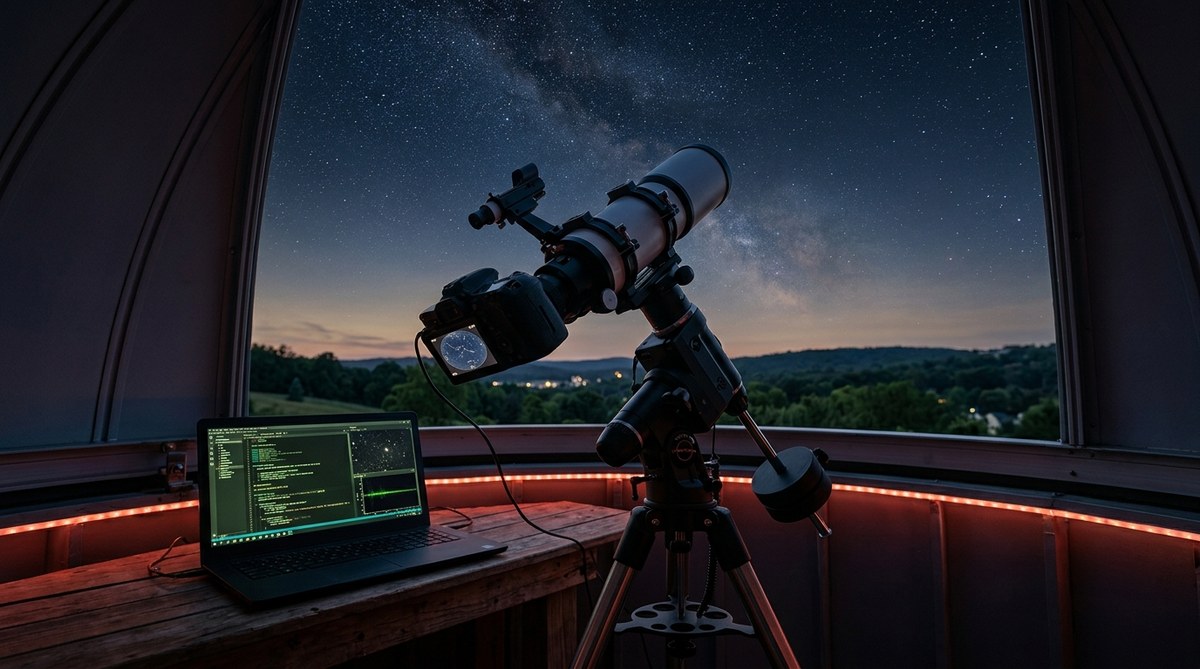
Install your AI framework. Python with scikit-learn is the most accessible choice. You can also use N.I.N.A. or Ekos with plugin support for external focus routines. If you are comfortable with the command line, a simple Python script that listens for focus requests works perfectly.
-
Write a data logger. Every time your existing autofocus routine runs, save the input variables and the resulting optimal focus position to a CSV file. Do this for at least two weeks of normal operation. The more data you have, the better the model will perform.
-
Train your first model. Load the CSV into a Jupyter notebook. Split the data into training and test sets. Train a random forest regressor with 100 trees. Evaluate the mean absolute error on the test set. If it is under 15 microns, you have a usable model.
-
Create a focus daemon. Write a script that loads the trained model at startup. Every time a focus check is triggered, it reads the current temperature, filter, and altitude, runs the prediction, and sends the focuser to that position. Then it takes a single frame and checks the HFR. If the HFR is above your threshold, it triggers a full V-curve and logs the new data point for retraining.
-
Monitor and retrain. Set up a weekly review of the model’s performance. If you see the prediction error creeping up, it is time to retrain with the new data. Over time, the model will become more accurate as it sees more seasonal variation.
“The biggest shift I made in 2026 was moving from a fixed V-curve schedule to an AI based predictive model. I went from losing 20 minutes per night to focus checks to less than two minutes. And my star FWHM values are more consistent than ever.”
* Tom S., remote observatory operator in Arizona
When AI focus is not enough
AI based HFR analysis observatory focus is powerful, but it is not magic. There are situations where even a perfect model cannot save you.
If your focuser has mechanical slop or temperature hysteresis, the model will struggle. The focuser must be repeatable to within a few microns for the AI to work reliably. If your focuser is old or has worn gears, replace it before investing time in automation.
If your camera has a stuck pixel or a damaged sensor, the HFR measurements will be noisy. Make sure your calibration frames are up to date. A bad master dark can inflate HFR values and confuse the model.
If the sky conditions are rapidly changing due to a passing front, the model’s predictions may be off. In those cases, let the validation HFR check decide. A single frame is cheap. If the HFR is bad, run the full V-curve. The AI is a tool to reduce the number of V-curves, not to eliminate them entirely.
Integrating AI focus with your broader observatory automation
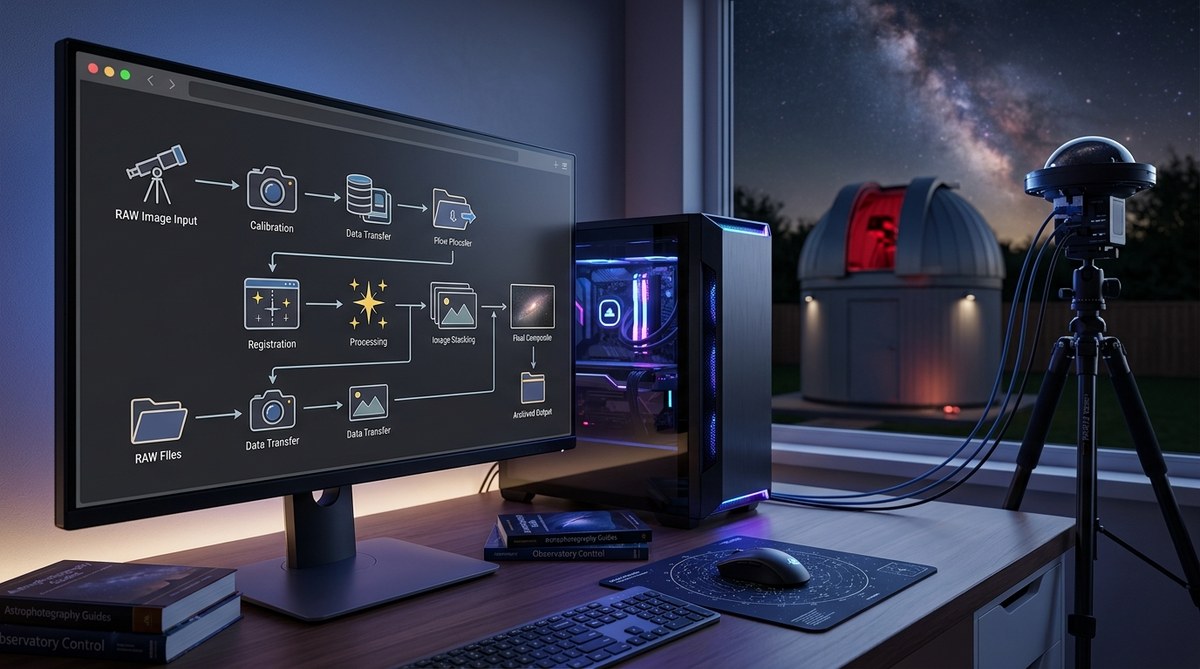
Your focus routine does not live in a vacuum. It interacts with your mount, your filter wheel, your weather station, and your imaging scheduler. The best setups treat AI focus as one component of a larger automation pipeline.
For example, you can tie the focus prediction to your weather data. If the temperature is dropping fast, the model can schedule a focus check sooner. If the wind is gusting and the seeing is poor, the model can skip the focus check altogether because the HFR will be inflated by atmospheric turbulence anyway.
You can also link it to your target selection. If you are imaging a bright galaxy, you might tolerate slightly softer stars. But if you are doing narrowband on a faint nebula, you want perfect focus. The AI can adjust its threshold based on the current target.
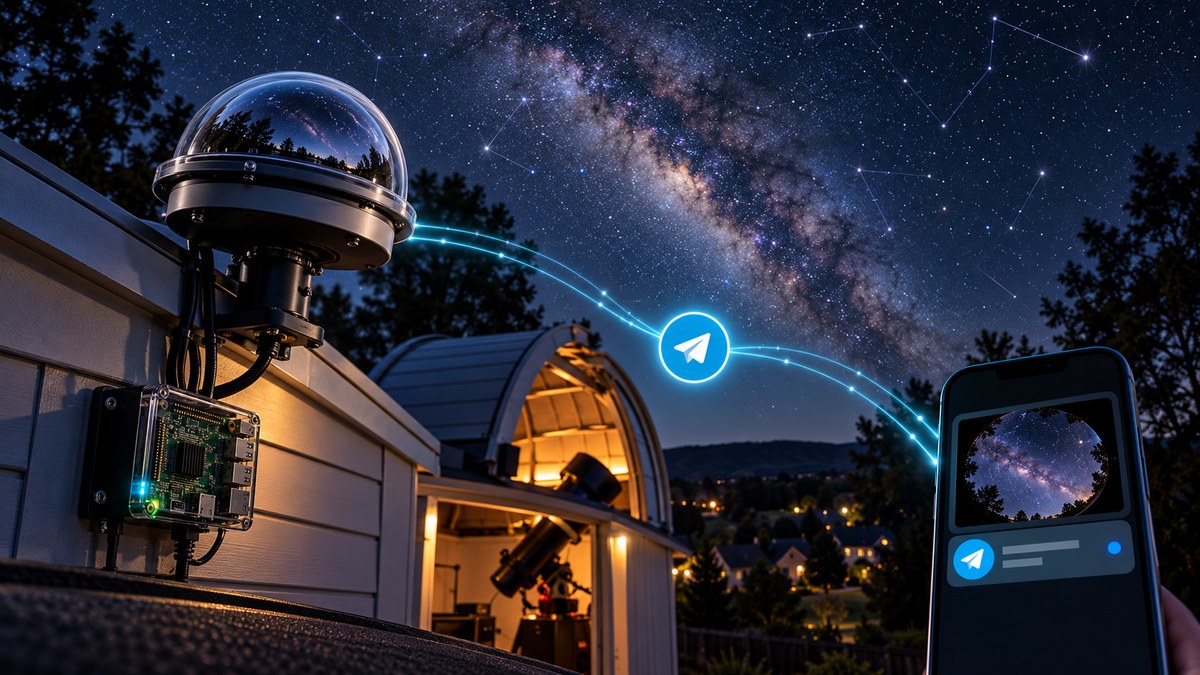
For a deeper look at how to connect all these pieces, check out our guide on building a fully automated all-sky camera system for under $300. The same principles of sensor integration and predictive logic apply to focus automation.
The future of AI based observatory focus
We are still in the early days. In 2026, most AI focus systems use supervised learning with manually collected data. The next step is reinforcement learning, where the model learns to optimize focus by trial and error, just like a human does but much faster.
Imagine a system that starts with no prior knowledge. On the first night, it runs a V-curve every 15 minutes. By the second night, it has learned the basic temperature relationship. By the end of the first week, it only runs a V-curve when the conditions change dramatically. After a month, it knows your telescope better than you do.
Some advanced setups are already experimenting with convolutional neural networks that analyze the full star field instead of just the HFR value. These models can detect asymmetric star shapes caused by tilt or collimation errors and adjust the focuser or even the secondary mirror to compensate. That level of automation is still experimental, but it will be mainstream within two years.
Getting started tonight
You do not need a PhD in machine learning to start using AI based HFR analysis observatory focus. Start small. Log your existing focus data for a week. Open it in a spreadsheet and look at the correlation between temperature and focus position. If you see a clear relationship, you are ready to build a simple linear model. From there, you can graduate to a random forest and eventually to a fully automated predictive focus routine.
The tools are free. The data is already being generated every time you run a focus routine. The only thing missing is the decision to stop treating focus as a manual chore and start treating it as a data problem.
If you are still using a manual Bahtinov mask or a periodic V-curve, you are leaving data on the table. Every night you spend manually focusing is a night you could be collecting photons. The stars do not wait for you to get your focus right. But with AI, your telescope can keep up.
For more ideas on automating your observatory, read about 5 essential scripts every remote observatory owner should be running and our guide on how to automate your backyard observatory with open-source software.
Your telescope is already smarter than you think
The hardware in your observatory is capable of incredible precision. Modern focusers can move in sub-micron steps. Cameras can measure HFR to two decimal places. The missing piece has always been the decision making layer that connects measurement to action. AI provides that layer.
Think about it this way. You already know that when the temperature drops, focus shifts. You already know that changing filters changes the focus. But you cannot be at the telescope every minute of every night. The AI can. It can watch the temperature trend, predict the shift, and correct it before you even notice.
That is the real promise of AI based HFR analysis observatory focus. Not just sharper images, but more time doing what you love. More sleep. More completed projects. Fewer ruined subs.
Set up your data logger tonight. Train your first model this weekend. By next month, you will wonder how you ever focused manually. The stars are waiting. Let your telescope do the work.

Post Comment