What Light Pollution Filter Should You Actually Use? A Decision Framework
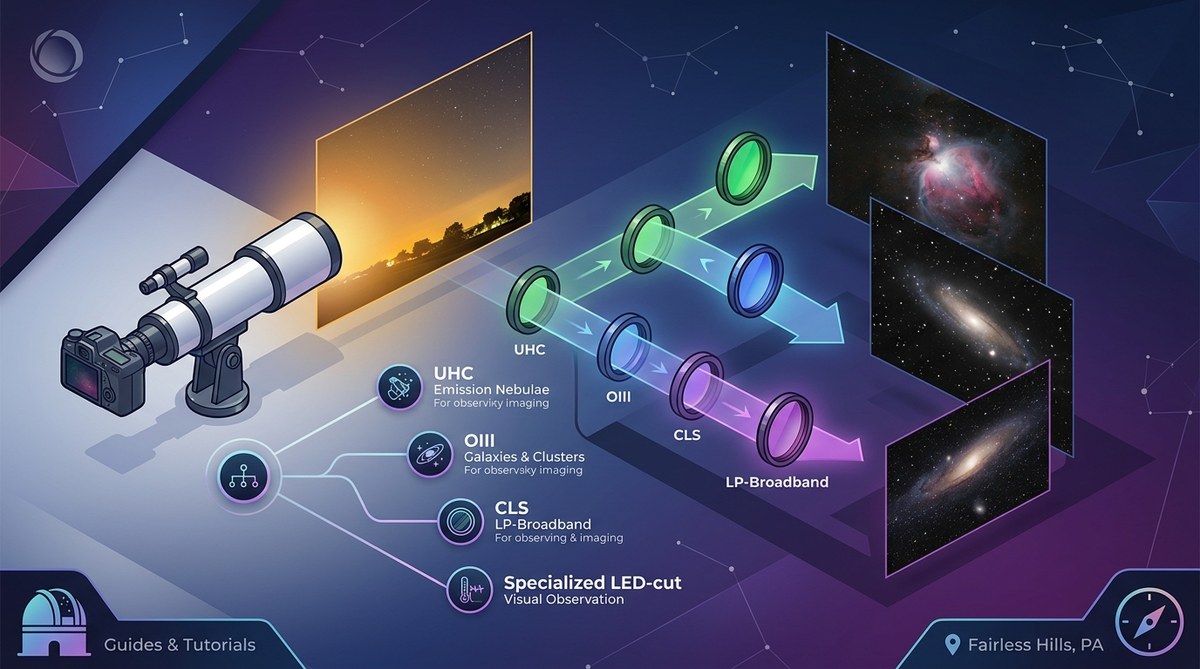
Amateur astrophotographers and stargazing enthusiasts often face a common challenge: how to capture clear images of the night sky in light-polluted environments. City lights, street lamps, and skyglow wash out celestial objects, making it tough to get detailed astrophotos. The good news is that using the right light pollution filter can make a significant difference. This guide offers a straightforward decision framework to help you pick the best filter for your specific urban imaging needs.
Selecting the right light pollution filter depends on your camera type, target objects, and local sky conditions. This guide simplifies the process, helping you make informed choices to improve your urban astrophotography results.
Understanding Light Pollution Filters and Their Role
Light pollution filters are designed to block or reduce specific wavelengths of artificial light that wash out the night sky. They allow more of the celestial light to reach your camera sensor while filtering out the unwanted glow from city lighting. Different filters target different types of light pollution, which makes selecting the right one critical.
Before jumping into recommendations, it’s helpful to understand the main types of filters available. They generally fall into three categories:
– Broadband filters
– Narrowband filters
– Multi-bandpass filters
Each type offers advantages depending on your location, target objects, and equipment. The goal is to maximize the contrast of celestial objects without sacrificing too much light.
How To Decide Which Light Pollution Filter Suits You Best
Choosing the right filter involves a few practical steps. Here is a simple process to guide your decision:
-
Identify Your Imaging Environment and Targets
Are you imaging bright objects like planets, lunar features, or brighter deep-sky objects? Or are you aiming to capture faint nebulae and galaxies? Your targets influence the type of filter you need. -
Assess Your Camera and Filter Compatibility
Do you use a DSLR, mirrorless camera, or dedicated astrophotography camera? Some filters work better with color cameras, while others are optimized for monochrome sensors. -
Evaluate Local Light Pollution Conditions
How severe is the skyglow? Is it mainly sodium vapor, LED, or a mixture? Different filters block specific wavelengths. For instance, sodium vapor lamps emit at narrow wavelengths, which some filters can effectively block. -
Match Your Target and Filter Type
Match broad filters for general light pollution reduction with your targets. For narrowband filters, focus on emission nebulae. Multi-bandpass filters can give you flexibility across a range of objects. -
Test and Adjust
If possible, try different filters under your specific conditions. Review your images for contrast improvements and decide if a particular filter is worth the investment.
Recommendations Based on Your Setup
Here are some common scenarios and suitable filter choices:
-
Urban astrophotography with a DSLR or color camera:
Consider broadband filters like the Optolong L-pro or Astronomik CLS-CCD. They are effective at reducing skyglow while preserving color fidelity. -
Deep-sky imaging of faint nebulae:
Narrowband filters such as Hydrogen Alpha or Oxygen III are best for isolating emission lines, especially if you want to enhance nebula contrast. -
Versatile imaging in mixed light pollution environments:
Multi-bandpass filters like the Optolong L-eXtreme or Antlia Triband RGB Ultra offer flexibility, allowing you to capture a variety of objects without changing filters. -
Planetary and lunar imaging:
Filters are less critical here. You may not need a light pollution filter unless you want to reduce glare from nearby city lights.
Common Mistakes When Choosing a Light Pollution Filter
| Technique or Mistake | Explanation |
|---|---|
| Using a broadband filter in heavily polluted skies | While broad filters reduce some skyglow, they might not sufficiently block specific light sources, leading to low contrast. |
| Ignoring your camera type | Some filters are designed for monochrome sensors and may not work well with color cameras, causing color shifts or reduced detail. |
| Focusing solely on price | Cheaper filters may introduce unwanted artifacts or not block certain wavelengths effectively. Investing in a quality filter pays off. |
| Not testing filters in your environment | Sky conditions vary; a filter that works well in one location may not perform as expected elsewhere. Always test before committing. |
“The most effective light pollution filter is one that matches your specific sky conditions and imaging targets. Blindly choosing a popular model without understanding your needs can lead to frustration.” — an experienced astrophotographer
Practical Tips For Getting The Most Out Of Your Filter
- Use a filter holder or filter wheel to easily switch between filters during imaging sessions.
- Ensure your filter is compatible with your camera’s sensor size and filter thread size.
- Keep filters clean and free from dust and fingerprints to avoid image artifacts.
- Combine filters with post-processing techniques for optimal results.
- Don’t forget to calibrate your images with flats and dark frames for best quality.
Final Thoughts On Light Pollution Filter Recommendations
In urban settings, the right filter can turn a bleak, glow-filled sky into a canvas of celestial detail. The key is to understand your environment, your targets, and your equipment. By following the decision framework outlined above, you can make a confident choice that enhances your astrophotography adventures.
Remember, no filter is a magic wand. It’s part of a broader workflow that includes proper exposure, calibration, and processing. Testing different options under your specific sky conditions will help you find the perfect match. With patience and the right tools, you can unlock stunning images even in the brightest city nights.
Embracing Your Urban Sky With Confidence
Selecting the best light pollution filter is a personal journey. It depends on your equipment, goals, and environment. Use this guide to navigate your options, experiment with different filters, and refine your approach. The night sky is full of wonder, and with the right filter, you will see much more of it. Happy imaging!

Post Comment