Why Our Fairless Hills All-Sky Camera Keeps Spotting Unexpected Zodiacal Light
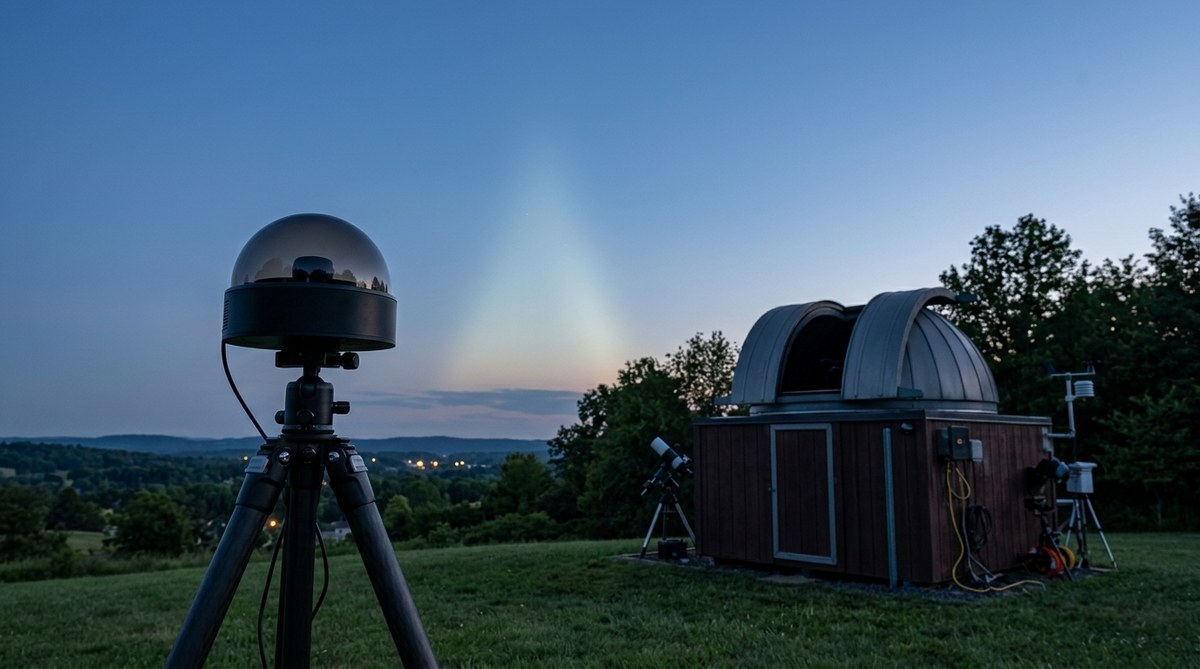
You sit down at your laptop to review last night’s all-sky camera footage from Fairless Hills. The sky looks clear. No clouds. No satellites. But there it is again: a soft, glowing pyramid of light rising from the eastern horizon just before dawn. It is not a city glow. It is not a distant wildfire. And it is not a meteor shower. It is zodiacal light, and it shows up far more often than most amateur astronomers expect.
Zodiacal light is sunlight scattered by interplanetary dust left over from the formation of our solar system. It looks like a faint, cone-shaped glow along the ecliptic. For amateur astronomers, it can confuse automated sky cameras and mimic light pollution. Knowing when and where to look for it will help you capture it, identify it, and enjoy one of the most underrated celestial sights of 2026.
What Zodiacal Light Actually Is
Zodiacal light is not a trick of the atmosphere. It is real. It comes from tiny particles of dust that orbit the sun in the same plane as the planets. When sunlight hits that dust, it scatters back toward Earth. The result is a soft, diffuse glow that stretches upward from the horizon.
The glow follows the ecliptic, which is the path the sun, moon, and planets trace across our sky. That is why it gets the name “zodiacal.” It appears inside the band of zodiac constellations.
Many people call it the “false dawn” because it can look like the first hint of sunrise, especially on moonless mornings. If you are a night owl who stays up late, you can also see it in the western sky after evening twilight fades.
Why Our All-Sky Camera Keeps Spotting It
Our all-sky camera at the JAT Observatory in Fairless Hills runs every night. It captures a full hemisphere of the sky in a single frame. That wide field of view is perfect for picking up faint, extended objects. Zodiacal light covers a huge area of sky, often 20 to 30 degrees wide at the base. A narrow telescope lens would miss it entirely. A fisheye lens catches it every time.
The camera also uses a long exposure setting, typically 30 seconds. That is enough time for the faint glow to register above the background noise. On nights with low humidity and no moonlight, the camera consistently records a brightening along the eastern horizon about 90 minutes before sunrise.
If you are running an all-sky camera yourself, you have probably seen the same thing. It is easy to mistake for light pollution from a nearby town. But real light pollution does not move. Zodiacal light shifts with the seasons and with the tilt of the ecliptic.
When to See It in 2026
Timing is everything. Zodiacal light is best seen when the ecliptic stands nearly vertical relative to the horizon. That happens at specific times of year depending on whether you are looking in the morning or evening.
For morning viewing in the Northern Hemisphere, the best window runs from late January through early March. That is when the ecliptic rises at a steep angle before dawn. In 2026, mark your calendar for February mornings. Pick a night with no moon. Get outside about 90 minutes before sunrise. Look east.
For evening viewing, the best time is from late March through early May. Right after evening twilight ends, look west. The glow will appear as a broad, faint triangle leaning into the sky.
Here is a quick reference for 2026:
- Morning (east): January 20 to March 10
- Evening (west): March 20 to May 10
These dates shift slightly depending on your latitude. If you live farther north, the window narrows. If you are in the southern United States, you get a longer view.
How to Observe It Without Special Gear
You do not need a telescope. You do not need a camera. You just need dark skies and patience.
Zodiacal light is subtle. Your eyes need time to adapt. Give yourself at least 20 minutes in complete darkness. Do not look at your phone. Do not turn on a flashlight. Let your night vision build.
Once your eyes are dark-adapted, scan the horizon slowly. The glow will look like a hazy pillar of light. It is brightest near the horizon and fades as it reaches higher into the sky. If you see a sharp cutoff at the top, you are looking at the gegenschein, which is a related phenomenon caused by backscattered light. But that is a topic for another night.
If you want to photograph it, use a camera with a wide-angle lens. Set your ISO to 1600 or 3200. Open the aperture as wide as it goes. Use a 20 to 30 second exposure. Focus manually on a bright star. You will see the glow in a single frame.
The Difference Between Zodiacal Light and Light Pollution
This is the most common mix-up. Light pollution from a city or suburb creates a dome of orange or yellow glow. It is usually brightest near the horizon and fades evenly in all directions. Zodiacal light is different. It is concentrated along the ecliptic. It has a triangular shape. And it changes position with the seasons.
If you look at your all-sky camera archive and see a glow that appears only in the east before dawn, and only during certain months, you are looking at zodiacal light. If the glow appears every night in the same spot regardless of season, that is light pollution.
Here is a table to help you tell them apart:
| Feature | Zodiacal Light | Light Pollution |
|---|---|---|
| Shape | Narrow cone or pyramid | Broad dome |
| Color | White or faint blue | Orange or yellow |
| Position | Along the ecliptic, shifts with season | Fixed around towns or cities |
| Best time | Moonless nights, specific seasons | Any night, any season |
| Visibility | Fades quickly with moonlight | Visible even with moonlight |
Three Steps to Confirm What You Are Seeing
If your camera keeps catching an unexpected glow, run through this checklist before you dismiss it as a nuisance.
- Check the date and time. Compare the glow to the known zodiacal light window for your latitude. If it is February at 5:00 AM, you have a strong candidate.
- Look at the shape. Is it a narrow triangle or a flat dome? A triangle points to zodiacal light. A dome points to light pollution.
- Track it over several nights. Zodiacal light moves. Light pollution stays put. If the glow shifts eastward night after night, it is the real thing.
Common Mistakes Amateur Astronomers Make
Even experienced observers get this wrong sometimes. Here are the pitfalls to avoid:
- Confusing it with the Milky Way. The Milky Way is much wider and contains visible stars. Zodiacal light is smoother and lacks structure.
- Blaming the camera. A lot of people think their all-sky camera has a sensor issue when they see a bright horizon. The camera is fine. The dust is real.
- Waiting too long. If you wait until the sky is fully dark, you might miss the best contrast. The glow is most visible when the sky is still very dark but the horizon is just starting to brighten.
- Using a moon filter. Moon filters reduce overall brightness. They also dim zodiacal light. Turn off any automated moon filters if you want to capture it.
“The zodiacal light is one of the most beautiful sights in the night sky, yet most people never see it because they do not know when to look. A simple all-sky camera will show it to you every clear night if you set it up right.” — JAT Observatory team note, February 2026
Why Astrology Enthusiasts Care About This Glow
You might wonder why a website that covers astrology pays attention to zodiacal light. The answer is simple. The zodiacal light follows the same path as the planets and the sun. It is a physical reminder of the plane of the ecliptic that defines the zodiac signs.
When ancient astrologers looked at the sky, they saw the planets moving through a narrow band of constellations. That band is the same band where zodiacal light appears. The dust that creates the glow is the leftover material from the formation of the solar system. It is the same stuff that comets shed and that meteor showers burn up in our atmosphere.
For anyone interested in the connection between the sky and astrology, observing zodiacal light is a way to see the physical structure behind the zodiac. It is not just a symbol. It is a real, measurable phenomenon.
If you want to go deeper, check out our guide on how to use your all-sky camera to track astrological transits. It explains how the same camera that catches zodiacal light can also follow planetary movements through the zodiac.
What to Do If Your Camera Keeps Triggering on It
Some automated observatory setups treat any brightening of the horizon as a sign of clouds or dawn. If your camera is programmed to stop capturing when it detects a bright horizon, zodiacal light will shut down your session early.
You have a few options:
- Adjust your sky brightness threshold. Set it high enough that zodiacal light does not trigger the cutoff, but low enough that actual dawn still stops the session.
- Add a seasonal override. During February mornings, tell your system to ignore the eastern horizon brightening for an extra 30 minutes.
- Use a different detection algorithm. Some software can tell the difference between a smooth gradient (zodiacal light) and a sharp boundary (clouds or city lights).
For more on automating your setup, read our guide on how to automate your backyard observatory with open-source software. It covers how to tweak detection thresholds for seasonal phenomena.
A Final Look at the False Dawn
Zodiacal light is not a problem. It is a gift. It is a visible link to the early solar system, and it appears in our sky every year without fail. The fact that it fools all-sky cameras just means the cameras are sensitive enough to see it. That is a good thing.
Next time you review your footage and see that soft glow rising before the sun, take a moment to appreciate it. You are looking at four and a half billion years of cosmic debris, lit by the same star that warms your face. That is worth a second look.

Post Comment