Why Our All-Sky Camera Keeps Catching the Zodiacal Light—and What It Means for Your Chart
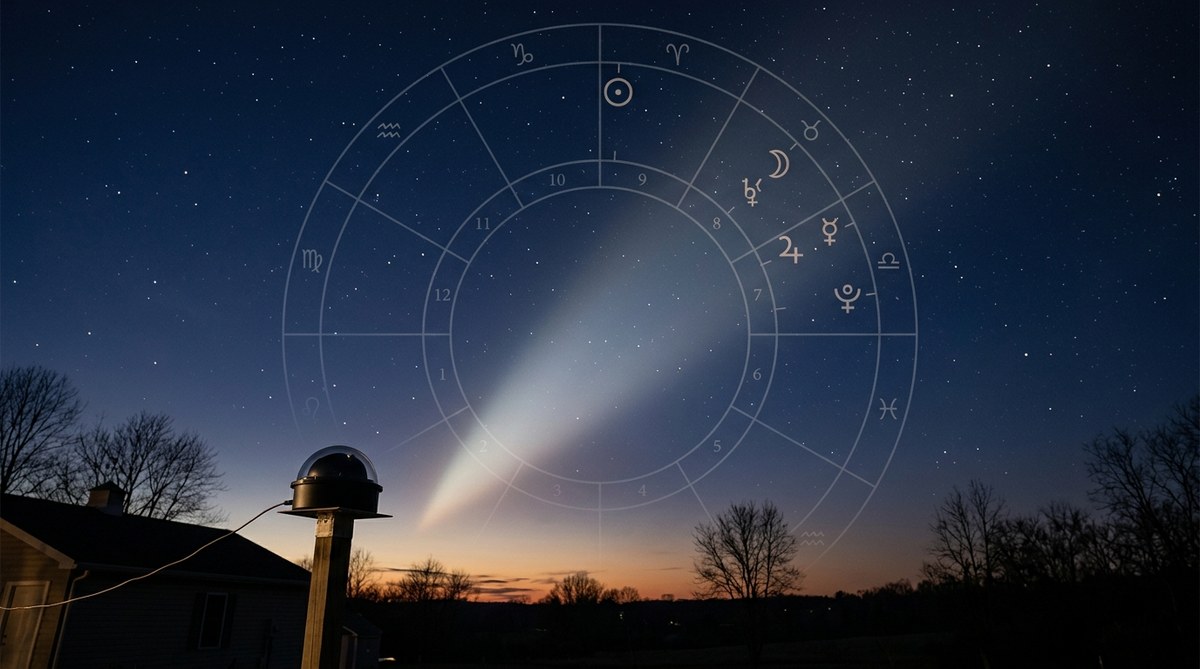
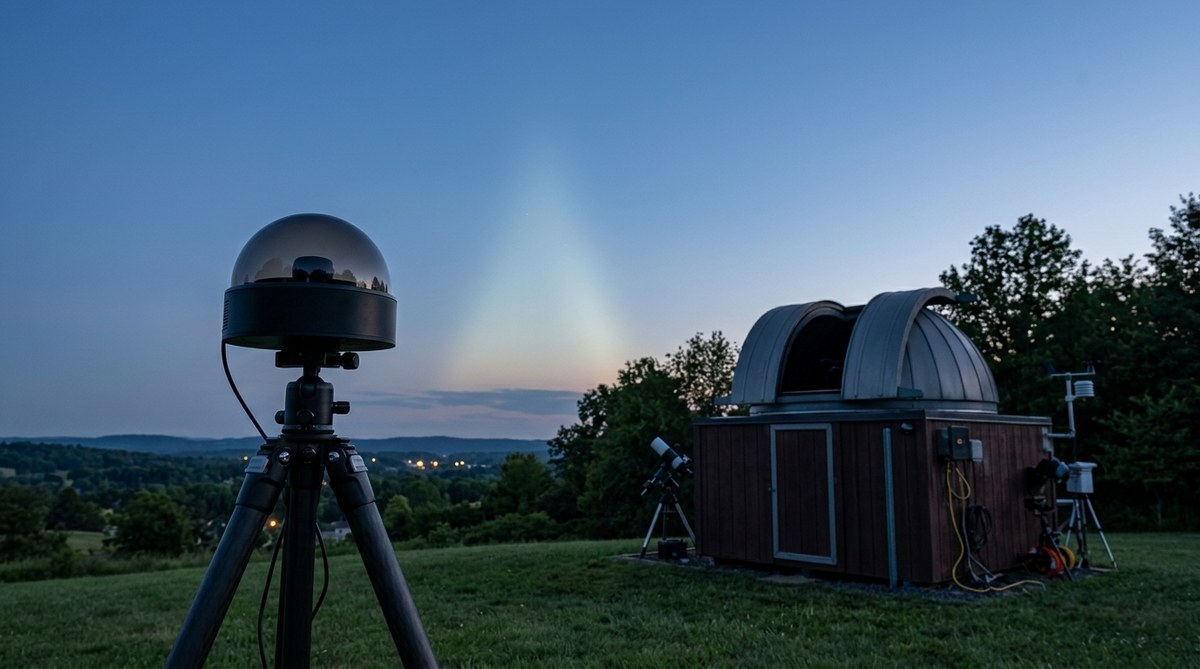
Your all-sky camera has been busy. You check the morning download and there it is again: a faint, triangular glow rising from the eastern horizon just before dawn. It looks like a pillar of light, or maybe the glow of a distant city you know isn’t there. This ghostly beacon is the zodiacal light, and if your camera keeps catching it, you are not alone. At the JAT Observatory in Fairless Hills, Pennsylvania, our all-sky camera records this phenomenon more often than you might expect. And for good reason.
The zodiacal light is sunlight reflecting off dust particles that orbit the sun in the same plane as the planets. It appears as a soft, glowing triangle before dawn or after dusk. For astrophotographers, it is a challenge to capture cleanly. For astrology enthusiasts, it represents the raw material of the solar system and can symbolize the boundary between the visible and the unseen in a birth chart.
What Exactly Is the Zodiacal Light?
The zodiacal light is not a trick of the lens. It is real, physical sunlight scattering off a cloud of interplanetary dust. This dust stretches across the inner solar system, following the same plane as the planets. That plane is called the ecliptic, and it runs right through the zodiac constellations. That is where the name comes from.
When you see the zodiacal light, you are looking at tiny particles left over from the formation of the solar system. Comets also shed some of this material as they pass through the inner solar system. The glow is faint, so you need a dark sky to see it. Light pollution from suburban sprawl often washes it out. But a sensitive all-sky camera can pick it up even when your naked eye cannot.
For amateur astronomers, the zodiacal light is a sign of excellent sky conditions. It means the air is clear and the horizon is free of haze. For astrophotographers, it is a nuisance that adds a gradient to wide-field images. For astrology enthusiasts, it is something more.
Why Our All-Sky Camera Keeps Catching It
Our observatory runs a dedicated all-sky camera every night. It captures the entire dome of the sky in a single frame. Because the camera is sensitive and we monitor the sky from a relatively dark location in Fairless Hills, we see the zodiacal light often.
The camera catches it for three main reasons:
-
Timing: The zodiacal light is visible only during specific windows. In the Northern Hemisphere, the best time to see it in the evening is from February through April, right after sunset. In the morning, the best window is from September through November, just before sunrise. Our camera runs all night, so it naturally catches these windows.
-
Sensitivity: Modern all-sky cameras use sensors that are much more sensitive than the human eye. They can accumulate light over long exposures. A 30-second exposure will reveal the zodiacal light even when the sky looks completely dark to you.
-
Consistency: We never skip a night. The camera runs on a schedule, rain or shine. Over the course of a year, it captures dozens of clear mornings and evenings when the zodiacal light is present. Most human observers would miss those opportunities because they are asleep or busy.
If you are running your own all-sky camera and you see a persistent glow near the horizon that moves with the seasons, you are probably looking at the zodiacal light. Check your images around the equinoxes for the strongest signal.
How to Photograph the Zodiacal Light Yourself
You do not need a fancy observatory to capture the zodiacal light. A standard DSLR or mirrorless camera on a tripod will do the job. Here is a step by step process that works well.
-
Find a dark location: Drive away from city lights. A Bortle class 3 or darker sky is ideal. Check light pollution maps online to find a spot near you.
-
Choose the right time: In spring, look west after evening twilight ends. In autumn, look east before morning twilight begins. The moon should be below the horizon. A new moon phase is best.
-
Use a wide angle lens: A lens with a focal length between 14mm and 24mm works well. Set the aperture to its widest setting, usually f/2.8 or faster.
-
Set your camera to manual: Use an ISO between 1600 and 3200. Set the shutter speed to 15 to 30 seconds. Focus manually on a bright star using live view.
-
Take multiple exposures: Shoot a series of 10 to 20 frames. Later, you can stack them to reduce noise and bring out the faint glow.
-
Process the images: Use software like Adobe Lightroom or a free tool like Sequator. Adjust the white balance to make the sky look natural. The zodiacal light will appear as a soft, warm cone rising from the horizon.
Common Mistakes and How to Fix Them
| Mistake | Why It Happens | How to Fix It |
|---|---|---|
| Glow is too faint | Light pollution or moon washout | Drive to a darker site or wait for a moonless night |
| Gradient looks artificial | Over processing in software | Use gentle curves adjustments and avoid clipping the blacks |
| Stars are blurry | Autofocus failed or camera moved | Use manual focus and a remote shutter release |
| Glow is not visible at all | Wrong season or time of night | Check a zodiacal light calendar for your latitude |
“The zodiacal light is one of the most rewarding faint sky phenomena to photograph. It teaches patience. You have to plan around the moon, the season, and the weather. But when you capture it cleanly, the image has a quiet beauty that few other subjects can match.” JAT Observatory Field Notes, 2026
What the Zodiacal Light Means for Your Astrological Chart
Astrology enthusiasts often look for meaning in celestial events. The zodiacal light sits at an interesting crossroads. It is physical dust, but it glows along the same path the planets travel. In a birth chart, the zodiacal light can represent the raw, unformed potential of the solar system itself.
Think of it this way. The planets in your chart show where energy is focused. The signs show how that energy expresses itself. The zodiacal light is the background material. It is the dust from which everything else formed. In symbolic terms, it can represent the unseen influences in your life: the habits you inherited, the cultural background you did not choose, the subtle patterns that shape your decisions without you noticing.
Some astrologers associate the zodiacal light with the asteroid belt or with the concept of the “primal soup.” It is not a planet, so it does not have a traditional rulership. But if you are building a personal practice, you might consider where the ecliptic falls in your chart. That line, the path of the zodiacal light, is always present. It connects all the planets in your chart. It is the thread that ties your Sun, Moon, and rising sign together.
If you want to go deeper, you can track the zodiacal light in the sky and compare it to your current transits. For example, if the zodiacal light is strong in the morning sky and you have a Venus retrograde happening, you might meditate on the idea of hidden beauty or unseen resources.
For a more structured approach, read our guide on how to use your all-sky camera to track astrological transits. It bridges the gap between what the camera sees and what the chart reveals.
The Science Behind the Glow
Let us get into the physics for a moment. The dust particles that create the zodiacal light are tiny. Most are between 1 and 100 micrometers in size. That is smaller than a grain of sand. They orbit the sun in a disk that extends from near the sun out past the orbit of Mars.
When sunlight hits these particles, it scatters in all directions. Some of that scattered light reaches Earth. The effect is strongest near the sun, which is why the zodiacal light appears close to the horizon. As you look higher in the sky, the glow fades.
The color of the zodiacal light is slightly warmer than the surrounding sky. It often looks yellowish or orange. That is because the dust scatters longer wavelengths more efficiently. This color difference helps distinguish it from airglow, which is a greenish or reddish emission from the Earth’s upper atmosphere.
Scientists study the zodiacal light to learn about the distribution of dust in the solar system. Changes in its brightness can indicate new dust from cometary activity. For amateur observers, it is simply a beautiful reminder that we are not alone in space. We are moving through a cloud of debris left over from the birth of the planets.
When Light Pollution Actually Helps
This might sound strange, but light pollution can sometimes make the zodiacal light easier to photograph. Here is why. In a perfectly dark sky, the zodiacal light is subtle. Your camera sensor might struggle to separate it from the natural sky background. But if you have a small amount of light pollution on the horizon, it creates a gradient. The zodiacal light sits on top of that gradient.
The key is to have light pollution that is uniform. A distant city glow that rises evenly from the horizon can act as a backdrop. Your camera will capture the zodiacal light as a brighter cone rising through that glow. This is not ideal for scientific measurements, but it can produce striking images.
At the JAT Observatory, we have noticed this effect during winter months. The light dome from Philadelphia and Trenton creates a low, even glow on the eastern horizon. On clear mornings, the zodiacal light rises through that glow and stands out clearly in our all-sky frames. It is a case where a suburban location actually works in your favor.
For more on how we handle less than perfect skies, check out our article on when light pollution actually helped: documenting noctilucent clouds from our observatory.
A Practical Checklist for Observing the Zodiacal Light
If you want to see the zodiacal light for yourself, use this list to prepare.
- Check the season. Spring evenings and autumn mornings are best.
- Pick a moonless night. The glow is faint and moonlight will hide it.
- Find a location with a clear, flat horizon. Oceans, lakes, and open fields work well.
- Let your eyes adapt to the dark for at least 20 minutes.
- Look for a soft, triangular glow about 20 to 30 degrees above the horizon.
- If you cannot see it with your eyes, try a long exposure photo. Your camera will see it first.
Many amateur astronomers report that the zodiacal light is easier to see after a cold front passes. The air becomes dry and clear. The dust particles in the atmosphere settle out, leaving the sky transparent. That is the perfect time to look.
Connecting the Zodiacal Light to Your Birth Chart
For astrology enthusiasts, the zodiacal light offers a unique tool. It is not a planet, an asteroid, or a fixed star. It is a phenomenon tied directly to the ecliptic plane. In your birth chart, the ecliptic is the line that runs through all the zodiac signs. Every planet and point in your chart falls somewhere along that line.
You can think of the zodiacal light as the “weather” of the ecliptic. When it is bright, the dust is dense. Symbolically, that might indicate a period when the background influences in your life are strong. When it is faint, the dust is sparse. That could suggest a time when you are more aware of your individual choices.
To apply this to your practice, note the times of year when the zodiacal light is visible in your location. Compare those dates to your current transits. If the zodiacal light is strong during a Saturn transit, for example, you might reflect on how your long term responsibilities are shaped by things you did not choose.
For a deeper look at how celestial events align with astrological traditions, read our piece on 5 celestial events that shaped astrological traditions and how to observe them today.
Why Your Camera Keeps Seeing It and You Do Not
This is a common frustration. You check your all-sky camera feed and see the zodiacal light clearly. But when you go outside to look, you see nothing. That is normal. Your camera has advantages your eyes do not.
Cameras accumulate light over time. A 30 second exposure gathers far more photons than your eye can in a glance. Your eye also has a narrower field of view. The zodiacal light is diffuse. It covers a large area of the sky. Your peripheral vision is actually better at detecting it than your central vision. That is why astronomers use averted vision: looking slightly to the side of a faint object to see it better.
Even with averted vision, the zodiacal light is tough. If you live in a suburban area with Bortle class 5 or worse skies, you might never see it with your eyes. But your camera will catch it on every clear, moonless night during the right season. That is the power of remote monitoring.
If you are building a system to catch these events, start with our guide on how to choose the right all-sky camera for your backyard observatory. It covers sensor sensitivity, lens selection, and mounting options.
The Zodiacal Light and the 2026 Sky
In 2026, the zodiacal light will be particularly well placed for observers in the United States. The spring equinox falls on March 20. That means the evening window for zodiacal light will be excellent from mid February through early April. The morning window will be best from late September through early November.
Plan your observing sessions around the new moons in March and October. Those are the darkest nights of the year for each window. If you have an all-sky camera, set it to run continuously from astronomical dusk to astronomical dawn. Review the images the next morning. You will likely find several frames showing the zodiacal light.
For astrophotographers, this is a great year to try a time lapse. Set your camera to take a frame every 30 seconds for two hours before dawn. Stack the frames into a video. You will see the zodiacal light rise and brighten as the sky darkens. It is a stunning effect.
Putting It All Together
The zodiacal light is a bridge. It connects the worlds of astronomy, astrophotography, and astrology. For the astronomer, it is a cloud of ancient dust. For the photographer, it is a challenging and rewarding subject. For the astrology enthusiast, it is a symbol of the unseen forces that shape our lives.
Your all-sky camera keeps catching it because the conditions are right and the camera is persistent. Now you know what it is and what it means. Next time you see that faint triangle in your morning download, you can appreciate it on every level.
Go ahead and check your camera feed tonight. You might just see the glow of the solar system’s oldest material, right there in your backyard. And if you want to learn more about what your camera is capturing, browse our collection of 5 unexpected meteor shower captures our all-sky camera recorded this year. The sky is always full of surprises.

Post Comment